Best Mini Rice Cookers for Small Kitchens: 2 Picks Worth the Counter Space
· NookPrep Editorial Team
Best Picks · Small Appliances
A rice cooker can be tiny and still waste space. The wrong one saves a few inches but leaves you cooking twice, cleaning awkward parts, or storing an appliance you stop using after a month.
For a genuinely small kitchen, the goal is not to find the smallest rice cooker on the internet. It is to find the smallest machine that still matches the amount of rice you actually cook. That is why our shortlist has only two models: the Dash Mini Rice Cooker DRCM200 for maximum space savings and simple single-person meals, and the Zojirushi NS-LGC05 Micom for buyers who want a compact cooker with far more control and enough capacity for a couple or small household.
Our two mini rice cooker picks
| Model | Capacity claim | Dimensions | Best for |
|---|---|---|---|
| Dash Mini DRCM200 | 2 cups cooked rice | 6.3 × 6.5 × 8.5 in | One person / smallest footprint |
| Zojirushi NS-LGC05 | Up to 3 cups uncooked rice* | 9⅛ × 11⅞ × 7½ in | Couples / frequent rice cooking |
*Important: these capacity labels are not directly comparable. Dash describes output as 2 cups of fully cooked rice. Zojirushi measures capacity with its approximately 180 mL cup of uncooked rice. We would not treat “2 cup” versus “3 cup” as a simple 50% capacity difference. Our rice cooker cup size guide explains why that 180 mL convention matters when measuring rice and water.
1. Dash Mini Rice Cooker DRCM200 — best for the smallest kitchens
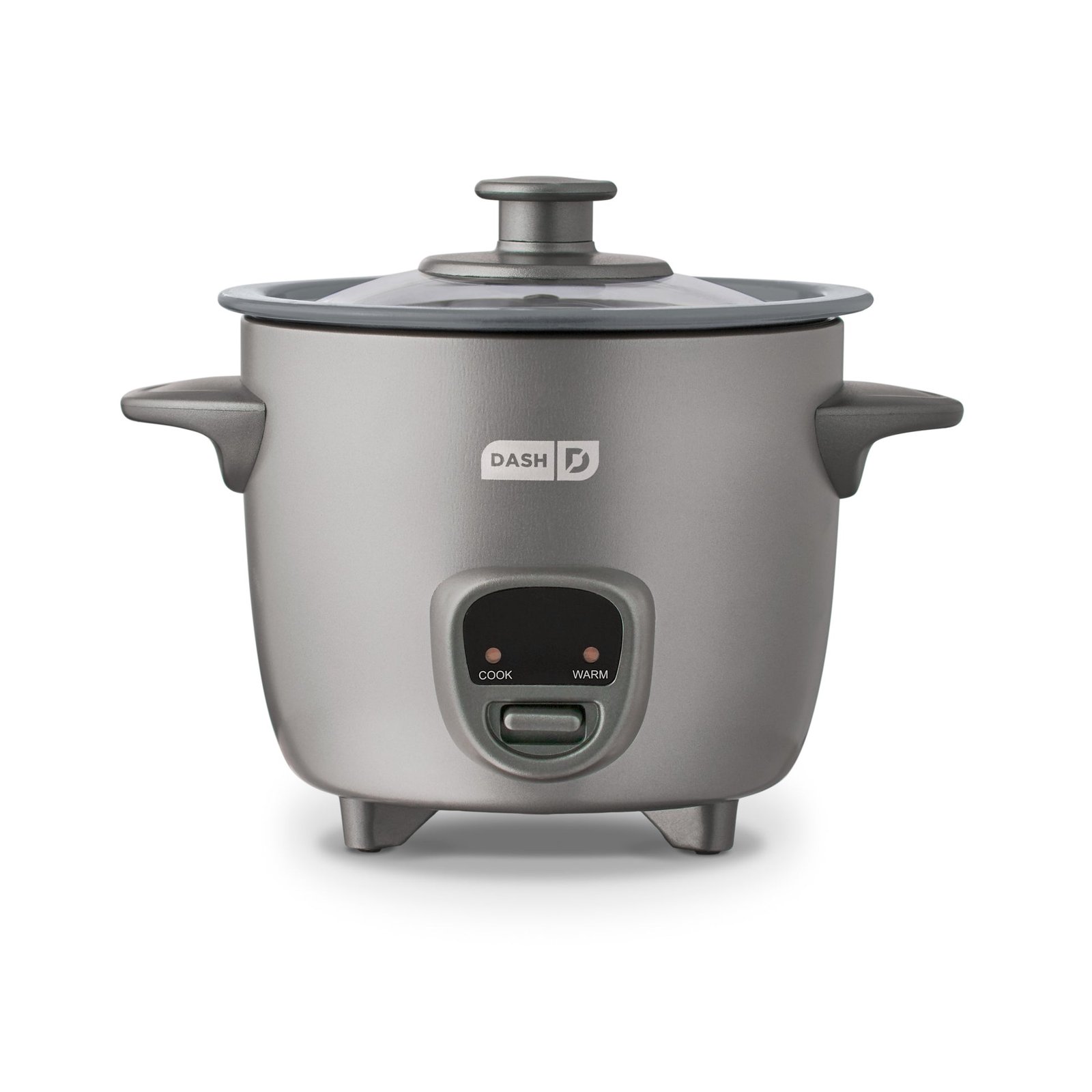
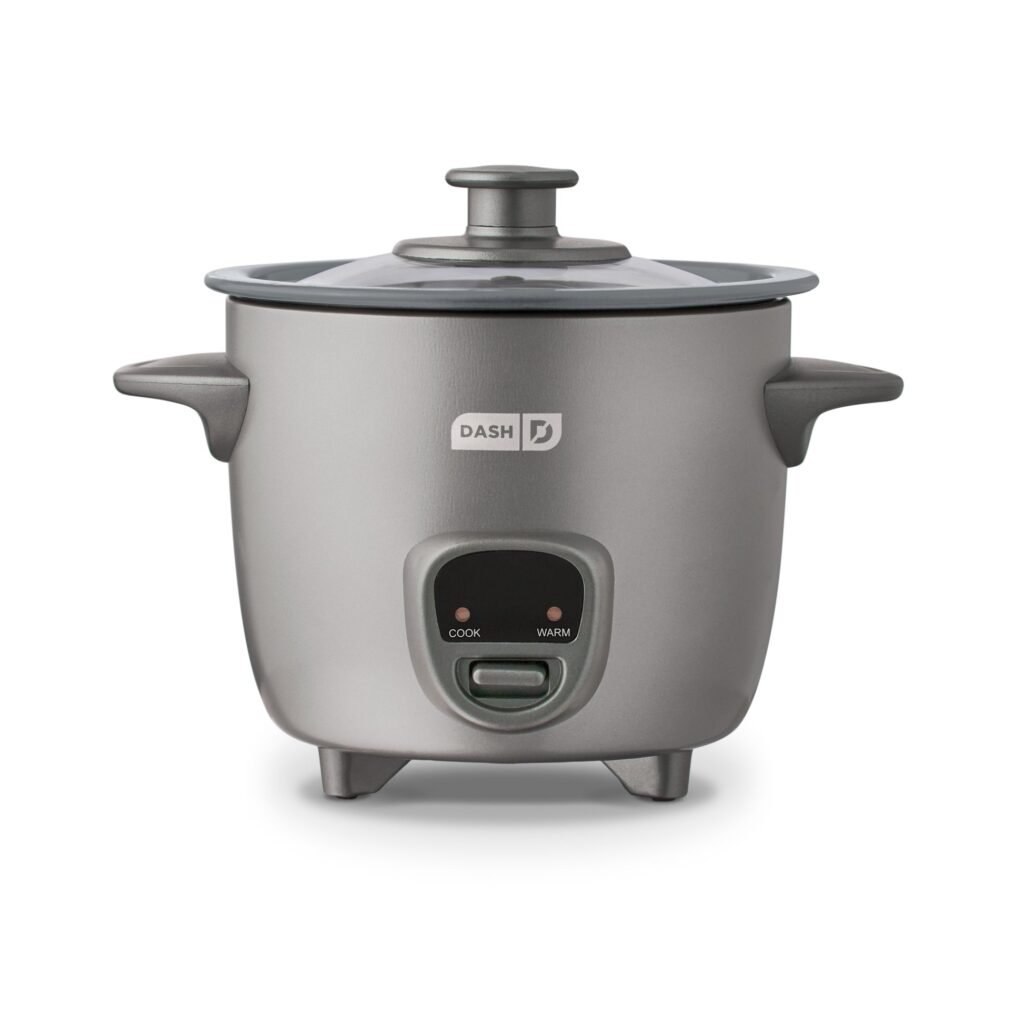
The Dash Mini is what “mini” should mean. Dash lists it at only 6.3 × 6.5 × 8.5 inches and 2.4 pounds, with a 200-watt power rating. That makes it dramatically easier to fit beside a coffee maker, tuck into a cabinet, or move in and out of storage than most multi-menu rice cookers.
Operation is deliberately basic. Add rice and water, press the cooking switch, and the cooker automatically moves to Keep Warm when the cycle finishes. The removable nonstick pot, glass lid, measuring cup and rice paddle are included. Dash also says the cooker can handle foods such as oatmeal, quinoa and pasta, which gives a tiny appliance a little more justification for occupying cabinet space.
The biggest advantage is also the limitation: it makes up to two cups of fully cooked rice. That can be ideal for one person who wants a fresh portion without leftovers. It is much less appealing if two people eat rice as a major part of dinner, because the small batch size can turn convenience into repeated cooking.
Only about 6.3 by 6.5 inches at the base, lightweight, one-touch operation, automatic Keep Warm and a removable pot.
Two cups of cooked rice is genuinely small. There are no dedicated brown-rice, sushi, timer or texture programs.
Buy it if: you live alone, cook modest rice portions, have almost no spare counter space, or want something light enough to store after every use.
Skip it if: you regularly cook rice for two or more people, want scheduled cooking, or care enough about different rice types to want dedicated programs.
Check Dash Mini Rice Cooker on AmazonView price →
2. Zojirushi NS-LGC05 Micom — best compact upgrade

The Zojirushi NS-LGC05 is not miniature in the Dash sense. It is 9⅛ inches wide, 11⅞ inches deep and 7½ inches high, so it asks for noticeably more counter depth. But the extra footprint buys a very different kind of appliance.
Zojirushi rates it for up to three of its approximately 180 mL cups of uncooked short-grain white rice, and it can cook as little as half a cup. Its microcomputer uses fuzzy-logic control to adjust cooking time and temperature, while a triple-heater design applies heat from the bottom, side and lid. The menu includes white/mixed rice, sushi rice, brown rice, GABA brown rice, long-grain white rice, steel-cut oatmeal and quick cooking.
For a small kitchen, two less glamorous features matter just as much: the power cord retracts into the body and the handle folds down. Those details make a compact appliance easier to move and store instead of leaving a loose cord tangled behind other countertop gear. Automatic Keep Warm, a reheating cycle, clock and timer functions also make the Zojirushi much more suitable for households that cook rice several times per week.
Useful 0.5-to-3-cup uncooked range, multiple grain programs, fuzzy-logic control, timer, reheat, retractable cord and fold-down handle.
It costs far more and occupies substantially more depth than the Dash. Buyers who only make occasional white rice may be paying for features they rarely use.
Buy it if: rice is a regular part of your diet, you cook for one or two people, and you want a compact cooker that can handle different rice styles without stepping up to a large family model.
Skip it if: your only goal is the smallest possible appliance or you make rice too rarely to justify a feature-rich dedicated cooker.
Check Zojirushi NS-LGC05 on AmazonView price →
Dash vs Zojirushi: the decision is really about frequency
These products look like direct competitors because both are small rice cookers. They are not. The Dash is closer to a dedicated portion-control appliance: minimal footprint, minimal controls, minimal commitment. The Zojirushi is a compact version of a serious everyday rice cooker.
That distinction matters more than a long feature checklist. If you cook rice once or twice a month, the Dash’s simplicity can be an advantage. If you cook it four or five times a week, saving a few inches with an ultra-mini cooker may be a false economy. Timer controls, reheating, different rice programs and a larger useful batch become more valuable every time you use them.
For appliances you use occasionally, optimize for storage. For appliances you use almost every day, optimize for usability first and footprint second.
How much counter space do you really save?
Looking only at width understates the difference. Using the manufacturers’ published width and depth as a simple footprint estimate, the Dash occupies roughly 41 square inches of counter surface before clearance, while the Zojirushi is roughly 108 square inches. Those are not installation-clearance measurements, but they illustrate why the Dash feels like a genuinely tiny appliance.
The tradeoff is capacity and control. A smaller footprint is valuable only until it forces extra batches or makes the appliance less useful. This is the same principle we use when comparing compact air fryers: the best small appliance is not necessarily the physically smallest one.
What we look for in a mini rice cooker
For NookPrep, compact kitchen gear has to justify the space it takes. We compare published exterior dimensions, usable capacity, storage-friendly details, controls, cleanup, power requirements and whether the appliance solves a recurring cooking problem. We also pay attention to how manufacturers define capacity because rice-cooker labels can be misleading when one brand describes cooked output and another describes uncooked rice measured with a proprietary cup.
We do not claim hands-on testing when we have not performed it. This guide is based on current manufacturer specifications, manuals, product documentation and buyer-use context, then filtered through a small-kitchen perspective. You can read more about our review methodology and editorial policy.
Do you even need a rice cooker in a small kitchen?
Not everyone does. If you already make rice reliably in a saucepan and only cook it occasionally, another appliance may not earn its storage space. A dedicated rice cooker becomes easier to justify when it removes a repeated task: measuring, monitoring heat, timing the finish, keeping rice warm, or coordinating rice with the rest of dinner.
That is why we would prioritize a rice cooker differently from a novelty gadget. For a rice-heavy household, it can be one of the most frequently used appliances in the kitchen. For someone who rarely eats rice, the same machine becomes clutter. Before buying, compare it with the appliances you already keep out and decide what deserves permanent space. Our guide to appliances worth counter space is built around exactly that decision.
Final verdict
The Dash Mini Rice Cooker is the better pure space-saver. Its tiny footprint and one-touch operation make sense for a single person, dorm, studio or anyone who wants small fresh batches without giving up much storage.
The Zojirushi NS-LGC05 is the better long-term appliance for frequent rice eaters. It takes more room and costs more, but the broader cooking range, timer, reheating and storage-friendly cord design make the extra footprint easier to justify when the cooker is used constantly.
In a small kitchen, do not buy capacity you will never use—but do not shrink so far that the appliance creates more work than it removes.
Compare our best compact air fryers, portable blenders, and compact food processors.
3 thoughts on “Best Mini Rice Cookers for Small Kitchens: 2 Picks Worth the Counter Space”
Comments are closed.