
This OXO Dish Brush Solves One Sink Problem—and Creates Another
· NookPrep Editorial Team
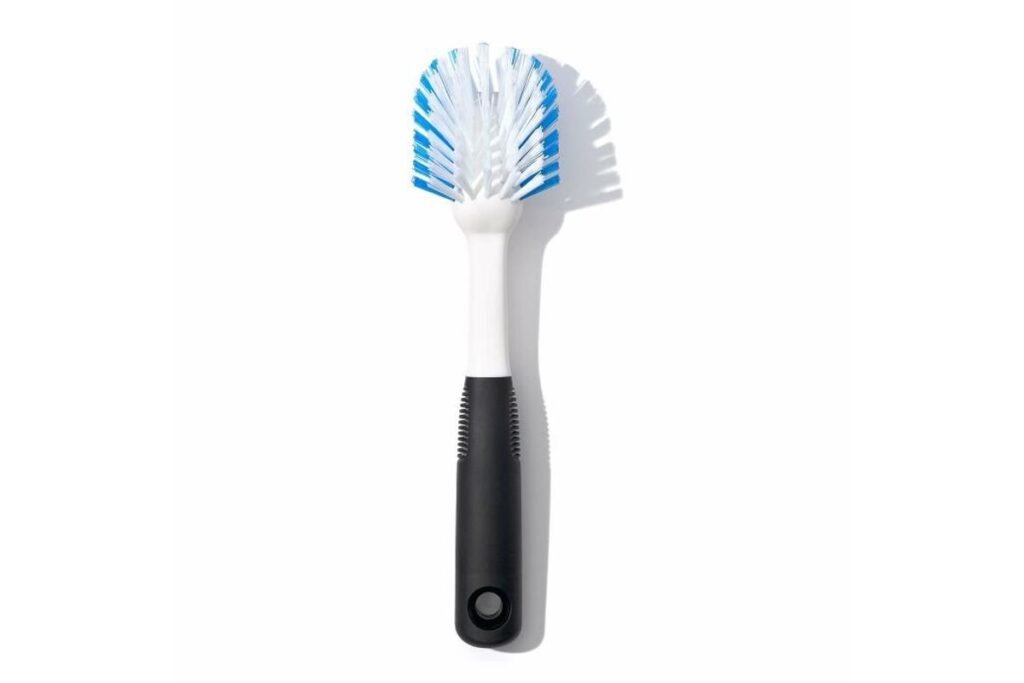
Quick verdict: The OXO Good Grips Dish Brush with Scraper is a strong fit for a small kitchen if you want one compact brush that can handle everyday plates, pan corners, and stuck-on food without adding another bulky cleaning tool. Its main limitation is simple: a fixed brush does not carry its own soap, so people who want a one-handed soap-dispensing routine may prefer OXO’s Palm Brush Storage Set instead.
Who this brush makes sense for
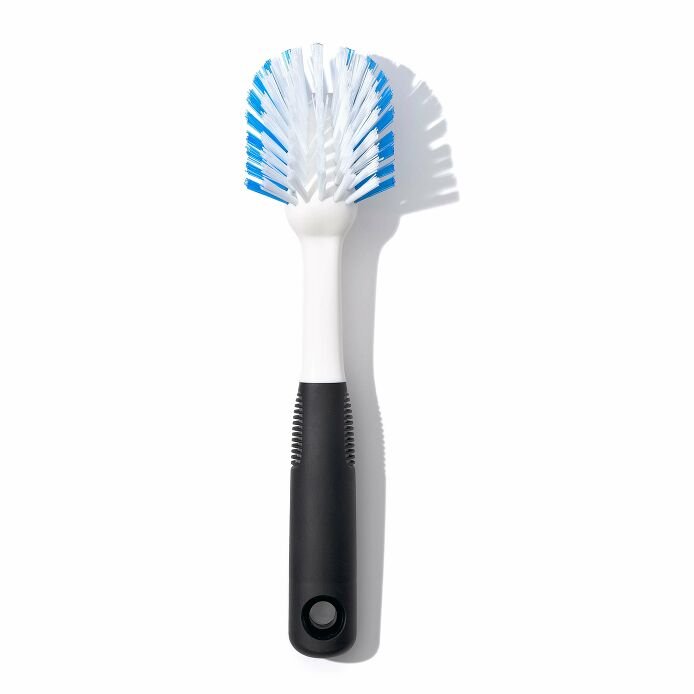
This is the kind of kitchen tool that earns space by being uncomplicated. OXO builds the brush around stiff nylon bristles, a flared head, a built-in scraper, and a soft non-slip handle. None of those features are unusual by themselves, but together they address the three annoyances that matter most at a small sink: reaching into cookware corners, loosening food that a sponge leaves behind, and keeping a secure grip when the handle is wet.
It is best suited to cooks who wash a mix of plates, pots, non-stick pans, and baking dishes by hand. If your kitchen already has a dishwasher but you still pre-clean cookware or wash a few items between cycles, the brush can also work as a low-friction “first tool” beside the sink. It is less compelling if you almost never hand-wash cookware, or if you specifically want soap stored inside the brush.
Best for: everyday hand-washing, pan corners, stuck-on residue, and buyers who prefer a simple handled brush.
Skip if: you want an integrated soap dispenser or a tiny palm-style footprint.
Biggest trade-off: better reach and leverage than a palm brush, but more handle length to store.
As an Amazon Associate I earn from qualifying purchases.
Check the OXO Dish Brush with Scraper on Amazon
The Real Test Is Whether It Reaches the Mess Without Punishing the Pan
For a dish brush, “cleaning performance” is too vague to be useful. The practical question is whether the brush can reach the surface you are trying to scrub without forcing you to use an abrasive pad that may be wrong for the cookware. OXO describes the nylon bristles as safe for non-stick cookware and shapes the head so the bristles flare outward toward corners. That combination is more meaningful than a generic claim that the brush is “powerful.”
In a small kitchen, a single brush that can move from dinner plates to the curved edge of a saucepan reduces the need to keep several specialty scrubbers around the sink. The built-in scraper adds another decision point: if food is stuck hard enough that bristles alone are inefficient, you can attack that spot without reaching for a separate plastic scraper.
Grip and leverage matter more than they look
OXO lists the brush at about 12.7 inches long. That is not a space-saving dimension in the way a palm brush is, but the handle changes how the tool works. You can keep your hand farther from greasy water, press into a pan with more leverage, and reach the bottom of deeper cookware without folding your wrist as sharply.
The soft, non-slip grip is also one of the more useful design details because dishwashing happens with wet hands. Still, comfort is personal. A long handle can feel easier for one person and less controlled for another, so the strongest reason to buy this model is not “ergonomics” in the abstract. It is the specific combination of reach, a secure grip, and a scraper in one tool.
What the built-in scraper changes in real use
The scraper is positioned for the messes that tend to make people soak a pan longer than they wanted: dried sauce around an edge, cooked-on egg, or a small patch of food that is too stubborn for bristles. OXO says the scraper is safe on non-stick cookware. That makes the brush more flexible than a stiff metal-edged cleaning tool, although cookware manufacturers’ care instructions should always take priority.
The trade-off is that a scraper does not replace soaking when food is heavily carbonized, and no brush design should be treated as permission to ignore a pan’s finish. Think of the scraper as a convenience feature for local stuck-on spots, not a universal replacement for every cleaning method.

Storage footprint: small tool, long handle
A brush this shape is easy to drop into a caddy, tall cup, or sink-side holder. It is less convenient in a shallow drawer because of the handle length. That is why the product is a stronger fit for people who already keep cleaning tools upright by the sink than for someone trying to keep every object hidden after use.
If counter clutter is your main frustration, pair the purchase decision with your storage plan. An upright caddy can turn a long handled brush into a tidy vertical item; without one, the brush may end up lying across the back of the sink. NookPrep’s OXO Stainless Steel Sink Caddy review looks at that second problem directly.
Dish Brush vs Palm Brush: which routine is better?
| Decision point | Dish Brush with Scraper | Palm Brush Storage Set |
|---|---|---|
| Reach | Better for deeper pots and pan corners | Better for close-control scrubbing |
| Soap storage | No built-in soap reservoir | Built-in soap-dispensing brush |
| Counter footprint | Longer tool; works well in a caddy | Compact holder footprint |
| Stuck-on spots | Built-in scraper is a practical advantage | Relies primarily on bristles |
| Best fit | Mixed cookware and everyday hand-washing | Small-sink users who want soap and brush together |
What we like—and what we would not oversell
What stands out: the brush combines a flared nylon head, scraper, wet-hand grip, and enough handle length to work across several types of cookware. It is also dishwasher safe according to OXO, which simplifies cleaning the cleaning tool itself.
The compromise: it does not solve soap dispensing or sink-side organization on its own. If those are the reasons you are shopping, a different product may give you more day-to-day value even if this brush is less expensive.
Before you buy: three small checks
First, check where the brush will dry. A handled brush is easy to use and surprisingly awkward to store if your sink has no caddy or rail. The handle should be able to stand or hang without resting wet bristles on the counter. Second, check the cookware you wash most. If nearly everything goes in a dishwasher and the only hand-washed pieces are delicate knives and glasses, a stiff dish brush may be more tool than you need. Third, decide whether you are actually trying to solve stuck-on food or soap dispensing. Those are different jobs, and buying the wrong brush shape will not fix the other one.
These checks sound basic, but they are exactly where a low-cost kitchen tool can become clutter. A small kitchen is not improved by owning the “best” version of a tool that does not match the routine. It is improved when one tool replaces a frustrating step without creating a new storage problem.
Should you buy the OXO Dish Brush with Scraper?
Buy it if your problem is scrubbing reach: pans, corners, baked-on spots, and a mix of hand-washed items. The design is straightforward and the features map cleanly to that problem. Skip it if your real problem is workflow clutter—soap bottle, brush, sponge, and drips all competing for a few inches around the sink. In that case, the Palm Brush Storage Set is the more relevant comparison because it combines the brush with a holder and soap dispensing.
See the current Amazon listing for the OXO Dish Brush with Scraper
Questions That Matter Before This Brush Replaces Your Sponge
Is the OXO Dish Brush with Scraper safe for non-stick pans?
OXO states that the nylon bristles and built-in scraper are safe for non-stick cookware. Even so, the pan maker’s care instructions should be the final authority, particularly for older or damaged coatings.
Does it hold dish soap?
No. This is a conventional handled dish brush, not a soap-dispensing model. If you want soap stored in the brush, OXO’s Palm Brush Storage Set is the closer fit.
Can it replace a sponge?
For many plates, pans, and stuck-on spots, it may reduce how often you reach for a sponge. It will not necessarily replace a soft sponge for wiping broad surfaces, glassware, or tasks where you want more surface contact and less bristle pressure.
Is it a good choice for a small kitchen?
Yes when you value one multi-purpose cleaning tool and have a vertical place to store the handle. If your counter is extremely tight and you want the smallest possible footprint, a palm-style brush may fit the space better.
The Brush Is Not Really Competing With Another Brush
The more useful comparison is between routines. A long-handled brush is competing with the sponge you keep reaching for, the plastic scraper buried in a drawer, and the habit of soaking a pan because touching the mess feels annoying. If the OXO replaces two of those motions, its value is easier to justify than if it simply becomes one more thing beside the faucet.
That distinction matters in a small kitchen because the cheapest tool is not automatically the lowest-cost tool to own. Every object needs a place to dry, a place to live, and a reason to survive the next decluttering session. A brush with a scraper can earn that space when the scraper removes a separate tool and the handle keeps your hand away from greasy water. If you still keep a sponge, bottle brush, pan scraper, and specialty scrubber beside it, the purchase has not simplified much.
A Sponge Still Wins at One Kind of Cleaning
The brush is strongest when pressure and reach matter. A sponge is often better when you want broad surface contact, a soft wipe, or the ability to fold around a rim or glass. That means replacing every sponge with this brush is the wrong goal. The better question is whether the brush takes over the jobs that make a sponge unpleasant: stuck food, greasy pan corners, and cookware that forces your hand deep into the sink.
This is also why “can it replace a sponge?” is less useful than it sounds. A small kitchen does not need one magical cleaner. It needs fewer overlapping cleaners. If the brush handles the dirty cookware and one soft sponge handles wiping and delicate surfaces, that two-tool system can be simpler than a drawer full of specialty scrubbers.
The Scraper Is Useful Only If You Know When to Stop
A built-in scraper is appealing because it promises a faster answer to dried food. It also invites a common mistake: treating every stubborn spot as something that needs more force. Even when OXO describes the scraper and nylon bristles as suitable for non-stick cookware, the coating maker’s care instructions should decide how aggressive you can be. A damaged or aging coating deserves more caution than a product label can account for.
Think of the scraper as a way to localize effort. Instead of scrubbing an entire pan harder, you can work on one dried edge and then return to the bristles. For heavily burned residue, soaking or a cookware-specific cleaning method can still make more sense. The product is convenient because it narrows the number of tools you need, not because it overrides material care.
The Long Handle Is Either the Best Feature or the Reason You Regret It
A 12-plus-inch handle changes both use and storage. In a deep pot, that length gives you reach and leverage. In a compact drawer, the same length becomes awkward. People who store cleaning tools upright in a caddy or cup are more likely to appreciate the geometry than people who want an empty counter after every wash.
Before buying, look at where the brush will be thirty minutes after dinner. If the answer is “lying wet across the sink divider,” the product may solve scrubbing while creating visual clutter. If you already have vertical storage with airflow around the head, the handle becomes much easier to live with. The ownership decision is therefore half about the sink and half about the storage around it.
Choose It by the Mess You Hate Most
If your recurring frustration is food stuck around pan edges, sauce dried onto a baking dish, or having to push your hand into a deep pot, this brush has a clear role. If the frustration is a soap bottle, wet sponge, and brush all competing for the same four inches of counter, the Palm Brush Storage Set is a more direct response. If the problem is that every cleaning tool ends up loose around the faucet, a caddy addresses the system rather than the scrubber.
That is the decision NookPrep would keep simple: do not buy the brush because it is a familiar OXO tool or because it is inexpensive. Buy it only when its handle and scraper replace a repeated annoyance you already have. Small tools become clutter when they solve imaginary problems.
Two Kitchens Can Buy the Same Brush and Reach Opposite Conclusions
Picture two small kitchens. In the first, cookware is washed by hand every night, the sink is deep, and a caddy already holds long tools upright. The OXO brush has a clear job: reach the bottom of pans, attack localized residue with the scraper, rinse, and return to the caddy. In that kitchen, the long handle solves more friction than it creates.
In the second kitchen, almost everything goes into a dishwasher, the counter is intentionally empty, and the only hand-washed items are glasses and one nonstick pan. A soft sponge may cover those jobs with less visual clutter. The exact same brush becomes unnecessary, not because the product changed, but because the routine did.
That is the useful way to read any small-tool review. Features matter only after they are matched to a repeated behavior. If the behavior is absent, even a well-designed tool can be the wrong purchase.
The Fastest Decision Shortcut
If you already own a sponge you like, ask whether the recurring problem is reach or stuck residue. If the answer is neither, keep the sponge. If you regularly avoid deep cookware because your hand ends up in dirty water, or you keep a separate scraper only for dried spots, the OXO has a clearer reason to exist. That shortcut prevents a low-cost purchase from becoming permanent sink clutter.
When to Skip It Without Overthinking the Decision
Skip the brush if your dishwasher handles almost everything, you rarely deal with stuck-on food, and a soft sponge already reaches the cookware you hand-wash. In that situation, the scraper and long handle solve problems you do not have. The purchase becomes stronger only when reach or residue is a repeated annoyance, not when you simply want a newer sink tool.
What This Review Is Based On
NookPrep did not perform hands-on lab testing for this article. We evaluated the current OXO product specifications, exact-model Amazon identity (ASIN B00004OCIZ), materials, dimensions, care information, and the small-kitchen use case. Prices and availability can change, so the purchase link is intended for checking the current offer rather than preserving a fixed price.
If Scrubbing Is Not the Real Problem
If the brush itself is not the hard part, move one step up the decision chain. Read our OXO Stainless Steel Sink Caddy review if your sink area needs organization, or compare the OXO Palm Brush Storage Set if you want a brush-and-soap system with a smaller visual footprint.
2 thoughts on “This OXO Dish Brush Solves One Sink Problem—and Creates Another”
Comments are closed.