Toaster Oven Burning Food? Fix Rack Position, Pan Choice, and Preheat Before You Replace It
· NookPrep Editorial Team
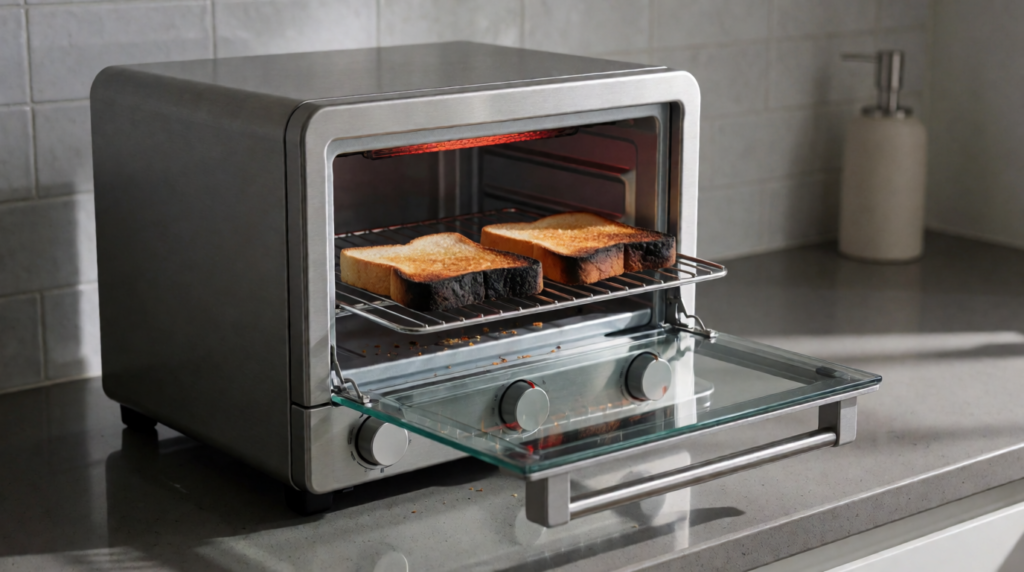
A toaster oven can go from pale to burnt fast enough to make you think the thermostat is broken. In a compact cavity, food sits much closer to the heating elements than it does in a full-size oven. That means rack position, pan choice, food thickness, and even where you place one slice can matter more than expected.
Before replacing the oven, identify where the burning happens. Top only? Bottom only? One side? Everything? The pattern is the diagnostic clue.
Quick answer: check these five things first
- Rack position for the selected function
- Distance from the upper/lower elements
- Dark vs light cookware and pan size
- Preheat behavior and actual cook time
- Food placement and portion thickness

The NookPrep Burn Pattern Map
| Burn pattern | Likely first suspect | First test |
|---|---|---|
| Top burns first | Too close to upper element / broil-like exposure | Use recommended lower rack position |
| Bottom burns first | Pan/element proximity | Check pan type and rack position |
| One side burns | Placement/airflow/hot spot | Center food and rotate if manual allows |
| Everything burns early | Time/temp mismatch or control issue | Reduce time and compare with known simple food |
1. Rack position is part of the cooking setting
Many toaster ovens assign different rack heights to different functions. Breville’s Smart Oven documentation, for example, specifies upper, middle, and lower positions for different modes rather than treating rack location as arbitrary.
If you use a broil-height rack for a normal bake, the food can sit much closer to the upper element than the recipe assumes.
2. Compact ovens punish oversized pans
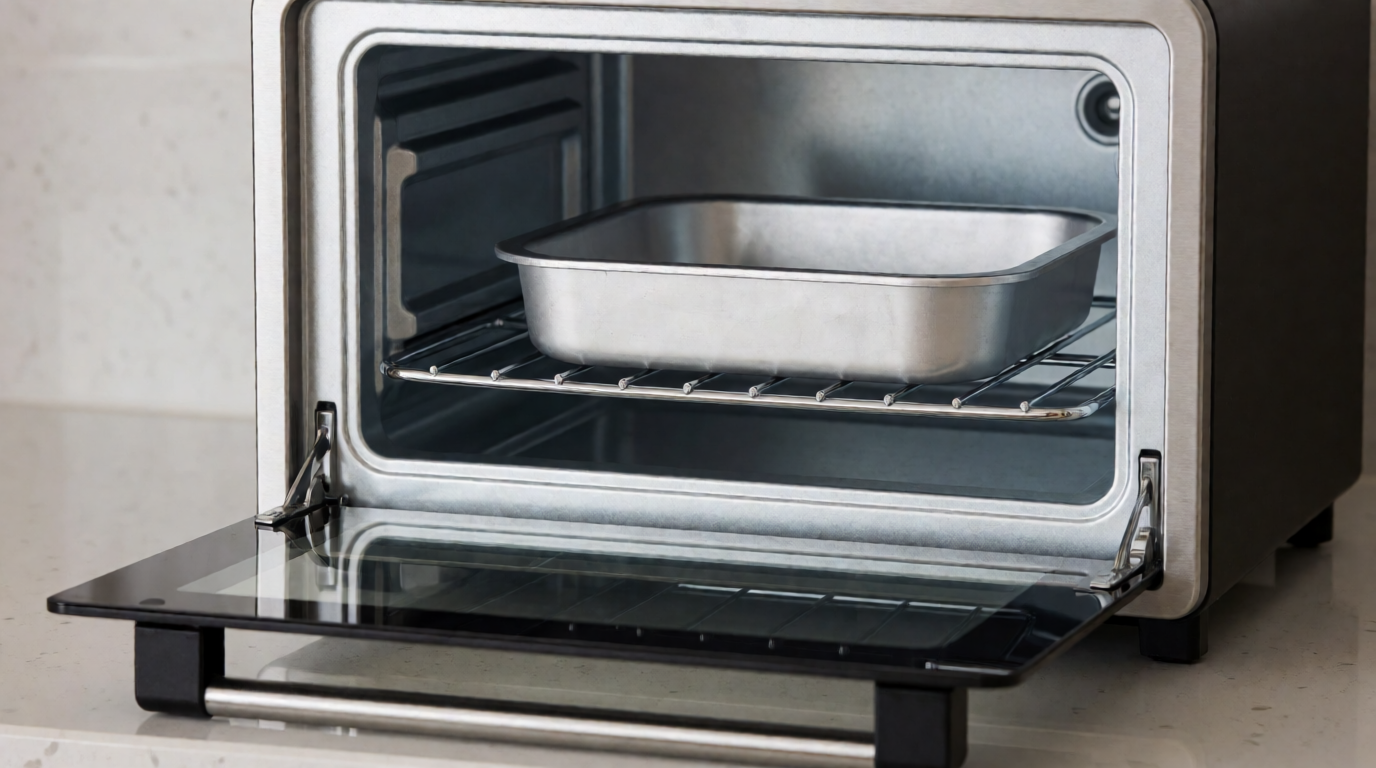
A pan that nearly fills the cavity can change airflow and place food closer to hot surfaces. Use cookware sizes the manufacturer allows, with clearance around the pan when specified.
Dark pans can also brown surfaces faster than light reflective pans in many baking situations. If the bottom repeatedly over-browns while the center needs more time, pan characteristics are worth testing before changing the oven.
3. Respect the preheat signal
If a recipe assumes a preheated oven and you load food during the warm-up, the heating elements may run aggressively while the cavity climbs to temperature. Some foods tolerate that; others brown unevenly.
Breville’s guidance for functions with a preheat cycle instructs users to wait until preheating is complete before placing food inside. Your model may behave differently, so follow its manual.
4. Centering matters more in a small cavity
One slice pushed against the back wall and one centered slice may not receive identical radiant heat. For toast and small portions, follow the manufacturer’s placement guidance rather than using the entire rack randomly.
If your oven tends to brown unevenly, run a simple controlled test with identical bread slices placed symmetrically. You are looking for a repeatable hot spot, not trying to “calibrate” the appliance from one complicated meal.
5. Check early; presets are starting points, not promises
Food thickness, starting temperature, pan, sugar content, and portion size all change browning speed. A preset cannot know every variation. Start checking before the final minutes when using a new food or pan.

When burning may indicate a real fault
If the oven burns simple food dramatically earlier than expected across multiple rack positions and settings, if controls behave erratically, or if the unit shows electrical or safety symptoms, stop experimenting and follow the manufacturer’s service guidance.
Do not open the housing or attempt electrical repairs unless you are qualified and the manufacturer procedure explicitly permits it.
What not to do
- Do not block vents to “hold heat in.”
- Do not use oversized cookware that contacts elements or walls.
- Do not treat Broil and Bake rack positions as interchangeable.
- Do not leave sugary or fatty foods unattended close to heating elements.
Browse compact toaster ovens on Amazon
Conclusion: burn location tells you what to test next
Top burn, bottom burn, one-sided burn, and all-over early burning are different clues. Start with rack position, cookware, preheat, and centered placement. Only after those variables are controlled does it make sense to suspect the temperature controls themselves.
If the deeper problem is that your current oven is too large or too close to cabinets, compare our compact toaster oven guide and air fryer vs toaster oven guide.
FAQ
Why does my toaster oven burn the top but not the bottom?
The food may be too close to the upper heating element for the selected function. Check the rack position recommended by your model’s manual before lowering temperature at random.
Why does food burn faster in a toaster oven than a full-size oven?
The cavity is smaller and the food can sit much closer to the heating elements. That makes rack position, pan size, food thickness, and early progress checks especially important.
Should I use the same bake time as a conventional oven?
Not automatically. Use the appliance manual and recipe as a starting point and monitor new foods early because compact-oven heat exposure can differ substantially from a full-size oven.
Sources & methodology
This article is research-based. We used Breville Smart Oven operating guidance for rack-position and preheat principles. Always follow the instructions and safety limits for your exact toaster oven.