
The OXO Sink Caddy Can Clear the Counter—or Become the Clutter
· NookPrep Editorial Team
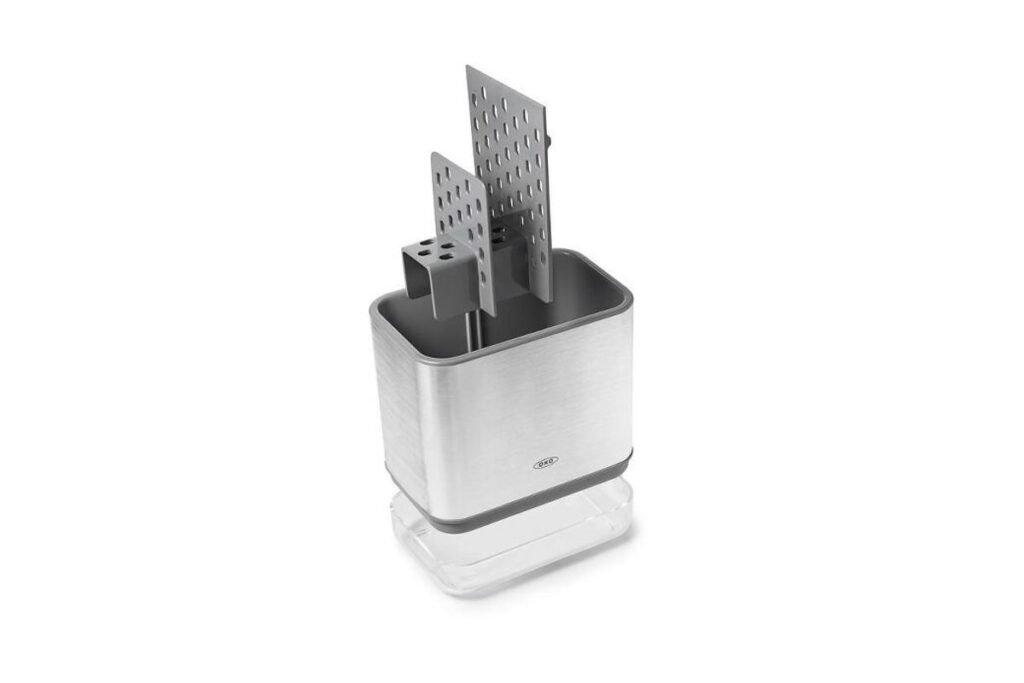
If your sink area already has the right brush and sponge but still looks chaotic, the OXO Good Grips Stainless Steel Sink Caddy is solving a different problem from most cleaning products. It does not clean anything by itself. Its value comes from giving wet tools a ventilated, drainable home in a footprint OXO lists at 5.6 by 3.8 by 5.5 inches.

Choose by sink scenario, not by “best organizer”
There is no universal best sink caddy because the right choice depends on what is currently taking up your limited space. The OXO caddy is a strong fit when you want to store a mix of brushes and sponges in one upright container. It is less ideal when you want to hide everything under the sink, mount storage to a wall, or carry cleaning supplies around the room.
Scenario A — two sponges + brushes: strong fit because the removable divider separates tool types and adds ventilation.
Scenario B — one big scrubber or odd-shaped tools: remove the divider and use it as a single open caddy.
Scenario C — almost no counter space: mixed fit; 5.6 × 3.8 inches is compact, but a suction or under-sink solution may preserve more usable counter.
As an Amazon Associate I earn from qualifying purchases.
Check the OXO Stainless Steel Sink Caddy on Amazon
Scenario A: you need wet tools to dry without becoming a pile
This is where the design makes the most sense. OXO uses a ventilated divider to separate brushes from sponges. Wet cleaning tools are easier to live with when they are not stacked directly against each other, and vertical separation makes each item visible instead of turning the caddy into a small bucket of mixed tools.
The important detail is that the divider is removable. That sounds minor, but it prevents the caddy from being locked into one layout. OXO says the divider can hold two sponges and two brushes, or you can remove it to create a single open space. That flexibility is useful when your cleaning routine changes.

Scenario B: drips are the real annoyance
A beautiful caddy that leaves a puddle underneath it is not solving the whole problem. OXO includes a built-in drip tray with a pour spout. That gives accumulated water somewhere to go and makes emptying it more deliberate than lifting a soaked sponge holder and wiping the counter underneath.
This is also the point where maintenance enters the decision. OXO lists the stainless-steel caddy as hand-wash only. Stainless steel can look cleaner than plastic in a visible kitchen, but water spots and soap residue still need attention. If your goal is “never clean the organizer,” no sink caddy can really deliver that.
Scenario C: you have a very small counter
The footprint is narrow—about 3.8 inches deep—but the overall width is 5.6 inches. Measure the clear area beside the sink rather than the empty counter somewhere else. Faucet handles, a dish rack, a soap dispenser, and the lip of an inset sink can reduce the usable rectangle more than you expect.
If you can spare the footprint, vertical storage makes better use of that area than laying a brush and sponge flat. If you cannot, a counter caddy is the wrong category regardless of how compact the model is.

A Sink Caddy Only Works If It Solves the Right Kind of Mess
| Decision point | What OXO offers | Why it matters |
|---|---|---|
| Footprint | 5.6″ × 3.8″ base area | Determines whether the caddy steals prep space |
| Drying | Ventilated divider | Separates damp sponges and brushes |
| Drainage | Drip tray + pour spout | Controls water under wet tools |
| Flexibility | Removable divider | Supports mixed tools or one open compartment |
| Care | Hand wash | Adds a small maintenance task |
Why stainless steel is both a benefit and a trade-off
Stainless steel gives the caddy a more permanent, appliance-like look than many plastic sink organizers. That can matter in a small kitchen because the sink zone is visually prominent. OXO also positions the material as durable and easy to wipe clean.
The trade-off is visibility. A reflective or brushed metal surface can show dried droplets, soap streaks, and fingerprints. If you prefer an organizer you can ignore cosmetically, a darker plastic caddy may feel lower maintenance even if it looks less polished.
How it compares with cheaper open caddies
A basic open plastic cup can hold a sponge and brush for much less money, so the OXO caddy has to justify itself through details rather than the simple act of holding tools. The removable divider makes items easier to separate, ventilation gives damp pieces more air around them, and the drip tray prevents runoff from simply pooling on the counter. Those are meaningful if the sink area is visible and used frequently.
On the other hand, if you are comfortable placing a cheap cup on a washable mat and emptying it often, you may not need the stainless shell or dedicated tray. “Better organization” is only valuable when it removes friction you actually notice.
How to keep the caddy from becoming clutter itself
Limit it to the tools you reach for every day. Extra bottle brushes, specialty scrubbers, cleaning tablets, and gloves are better stored elsewhere. A small caddy looks organized when each item has breathing room; once it is overfilled, the ventilation and quick-access benefits disappear. Keeping the divider in place also makes it obvious when you have exceeded the intended capacity.
What should go in it?
The caddy is most convincing when it replaces loose sink clutter rather than adding to it. A practical setup is one handled dish brush, one bottle brush or specialty brush, and one or two sponges. If you already have a dedicated soap-dispenser brush, you may not need both a caddy and a separate holder system.
For example, the OXO Dish Brush with Scraper benefits from a vertical home like this because its long handle is awkward to store flat. By contrast, the Palm Brush Storage Set already includes its own holder, so pairing it with this caddy duplicates storage.
Before you buy: measure the “wet zone,” not the counter
Countertop measurements can be misleading because the area beside the sink behaves differently from open prep space. Water splashes, faucet handles sweep through an arc, dish racks overhang, and soap bottles need room to pump. Place a rectangle roughly 5.6 by 3.8 inches where the caddy would live and make sure the faucet and daily tools still work naturally around it.
This is also a good moment to count what you actually plan to store. If you have five long brushes, two sponges, a bottle brush, and gloves, the OXO caddy may be too small. If you have one or two brushes and a couple of sponges, the organizer’s compactness becomes an advantage rather than a constraint.
Should you buy it?
Choose the OXO Stainless Steel Sink Caddy if you already know which cleaning tools you like and simply need a tidy, drainable station for them. It is especially sensible for an apartment kitchen where wet tools are currently spread across the sink edge or countertop.
Skip it if your main goal is to reduce the number of objects beside the sink. In that case, an integrated soap-dispensing brush system may consolidate more pieces. Also skip it if you do not have a permanent 5.6-by-3.8-inch area that can stay dedicated to cleaning gear.
See the current Amazon listing for the OXO Stainless Steel Sink Caddy
Three Things to Check Before It Lives Beside the Faucet
Can the divider be removed?
Yes. OXO specifically describes the divider as removable, allowing the caddy to work either as separated brush-and-sponge storage or as one open compartment.
Does it have drainage?
It uses a detachable drip tray with a pour spout. Water is collected underneath the tools and then emptied manually.
Can it go in the dishwasher?
OXO lists this stainless-steel caddy as hand wash only. That matters if dishwasher-safe organizers are a priority for you.
Is it worth buying if I already have a palm brush holder?
Usually only if you also have several other loose tools that need storage. If the Palm Brush Storage Set already contains your main scrubber and holder, a second caddy can add clutter rather than remove it.
One-week test before adding more sink storage
A sink caddy can solve clutter, but it can also become the place where every cleaning tool accumulates. After setting up the OXO, limit the caddy to the tools you actually use for one week. If a brush or sponge never leaves its slot, move it out of the wet zone rather than keeping it there “just in case.” This keeps the ventilation useful and makes the organizer easier to wipe down.
The same test helps you avoid buying a second organizer unnecessarily. If the caddy comfortably holds the daily brush-and-sponge set, extra sink storage may create more visual clutter than capacity. In a small kitchen, the cleanest system is often one visible wet-zone organizer plus less-used supplies stored elsewhere.
A Caddy Cannot Organize a Sink That Has Too Many Daily Tools
The easiest way to misuse a sink caddy is to treat every available slot as permission to add another item. A brush, sponge, bottle brush, scraper, drain tool, cloth, and backup sponge can all technically fit around a sink, but the caddy does not make each one necessary. The product works best when it contains a deliberately small wet-zone kit.
Before buying, list what actually gets wet every day. Those items deserve ventilated, reachable storage. Tools used once a week can dry and move elsewhere. This simple separation matters more than the material of the organizer because it determines whether the caddy looks intentional or overloaded.
Drainage Helps, but Airflow Still Needs Space
A drip tray manages water that falls from brushes and sponges. It does not magically dry an item that is packed tightly against another wet surface. A sponge pressed between several tools can stay damp longer even when the base underneath it is designed to collect water.
That means divider layout matters. Give absorbent items enough room to breathe, and avoid stuffing the organizer simply because another object fits. In a narrow sink area, a slightly under-filled caddy often works better than a maximized one because the visible space around each tool makes cleaning and drying easier.
Stainless Steel Looks Cleaner Than Plastic—Until Water Marks Show Up
Many buyers choose stainless steel because it visually matches faucets and appliances and feels less like a utility bin. The trade-off is that polished metal can make water spots, soap residue, or fingerprints more noticeable than a matte plastic surface. Appearance therefore depends on how often the caddy itself gets wiped.
If you want the sink area to look consistently neat, treat the organizer as part of the cleaning routine. Empty the drip tray, wipe the surrounding counter, and rinse residue before it accumulates. An organizer that stores cleaning tools is still an object that needs cleaning.
The Right Capacity Is Smaller Than “Everything That Fits”
Capacity sounds like a benefit, but small kitchens often improve when visible storage has a hard limit. If the caddy comfortably holds one sponge and one or two brushes, that can be enough. Once it becomes a general-purpose container for gloves, scrubbers, bottle tools, clips, and random sink accessories, it starts hiding clutter instead of solving it.
A useful rule is one active tool per job. One general scrubber, one soft wiping item, and one specialty tool only if you use it frequently. Extra supplies can live under the sink. The caddy then becomes a workflow station rather than a catch-all.
Buy the Caddy Only After You Decide What Should Stay Visible
This product makes the most sense when the objects are already correct and the storage is wrong. If you love your current brush and sponge but dislike where they sit, the caddy directly addresses the problem. If you dislike the brush, dislike the sponge, and dislike the soap bottle, buying an organizer first may preserve a system you were already unhappy with.
That is the larger small-kitchen lesson: storage products should follow editing, not replace it. Decide what deserves the wet zone, then choose the smallest organizer that gives those items a stable home.
The Counter Can Be Small and the Wet Zone Can Still Be Too Big
People often measure total counter width when the useful measurement is much narrower: the wet zone between the faucet, sink edge, dish rack, and whatever needs to remain dry. A caddy can fit on the counter and still interrupt the place where you set a rinsed cup or rest a cutting board.
Measure the exact strip where the caddy would live while the kitchen is in use, not when everything is cleared for a photo. Turn the faucet handle, open any nearby cabinet, and imagine a full dish rack. If the caddy blocks one of those motions, the footprint is too expensive even if the product dimensions look compact.
This is also why wall-mounted or in-sink storage can be better for some kitchens. The OXO caddy is strongest when you already have a stable horizontal landing area and simply need the tools contained.
The Fastest Decision Shortcut
Take every loose wet tool away from the sink for one day, then return only the ones you actually reach for. If that small group still has nowhere sensible to dry, the caddy has a real job. If the counter looks fine once unused tools are removed, buying another organizer may simply rebuild the clutter you just cleared.
When to Skip It
Skip the caddy if your daily wet-zone kit is already small and has a place to dry, or if the only available counter strip is needed for food prep and dishes. An organizer that steals a critical landing area can make a compact sink feel tighter even while the brushes look tidier.
Bottom line: this is a storage solution for tools you already want to keep near the sink. It is not a reason to keep more tools near the sink. That distinction is what separates useful organization from organized clutter.
One last test is cleaning the organizer itself. If the caddy is squeezed tightly between the faucet and a rack, removing the tray or wiping behind it may become another chore. Leave enough clearance to lift, empty, and clean the caddy without rearranging the whole sink area.
The caddy should also make the sink easier to reset at the end of the day. If emptying the tray, rinsing the divider, and wiping the counter can happen without moving several other objects, the system stays simple. If the organizer is wedged into a crowded corner, even a good drainage design can become one more thing you postpone cleaning.
How We Evaluated the Fit
NookPrep did not hands-on test this caddy. We evaluated OXO’s current specifications for SKU 13192100, exact-product Amazon identity (ASIN B01N06UEH4), material, dimensions, drainage layout, care instructions, and how the footprint fits common small-kitchen sink scenarios. Price and stock can change.
Fix the Sink Problem, Not the Category
Work backward from your sink problem. If the problem is scrubbing, start with the Dish Brush with Scraper. If it is soap + compact storage, choose the Palm Brush Storage Set. If it is organizing tools you already own, this caddy is the cleanest fit of the three.
2 thoughts on “The OXO Sink Caddy Can Clear the Counter—or Become the Clutter”
Comments are closed.