The YouCopia Bakeware Rack Saves Your Pans From the Stack—At a Cost
· NookPrep Editorial Team
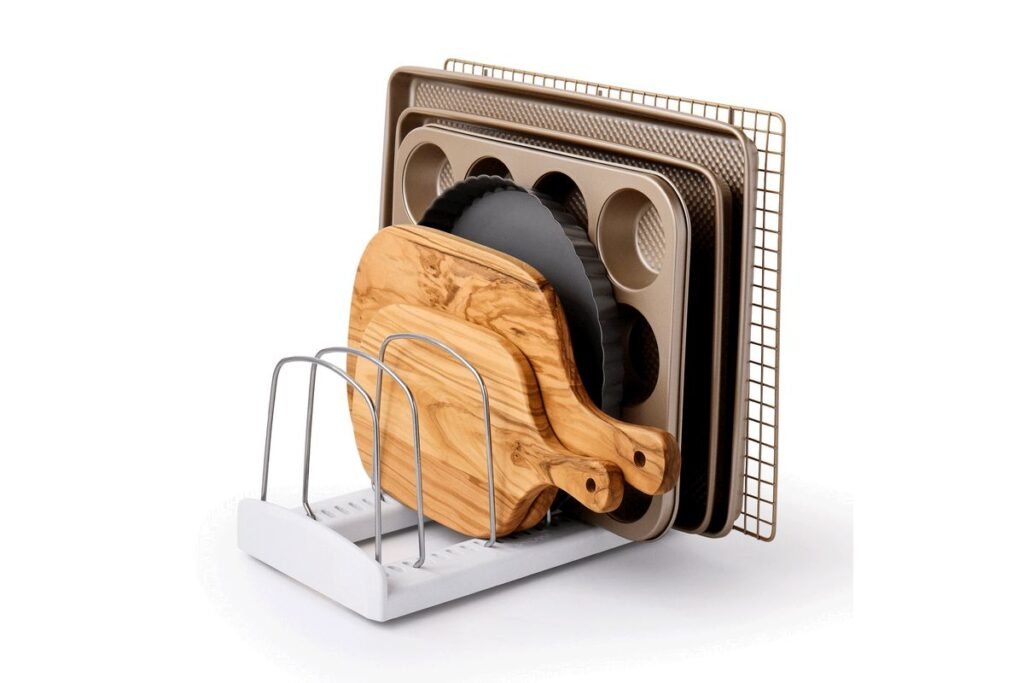
Stacked baking sheets look efficient until you need the one on the bottom. Then the cabinet becomes a lifting exercise: remove the pans above it, pull out the sheet, and rebuild the stack. The YouCopia StoreMore Bakeware Rack is designed to change that motion by storing sheets, boards, racks, and pans upright between adjustable dividers.
Quick answer: it solves access, not cabinet capacity
This rack is a strong fit if your problem is horizontal stacking. YouCopia’s current StoreMore Bakeware Rack uses seven adjustable coated-steel dividers, a thick recycled-plastic base, and non-slip feet. The manufacturer lists it at 11.6 inches wide, 7.4 inches deep, and 6.4 inches high with dividers inserted. That means it can turn a lower cabinet or pantry shelf into vertical slots—but only if you already have enough height and width for the items you want to stand up.

Problem it solves: pulling one sheet pan or cutting board without unstacking everything above it.
Problem it does not solve: a cabinet that is too narrow or too short for vertical storage.
Biggest trade-off: the rack uses some cabinet width in exchange for much faster access.
As an Amazon Associate I earn from qualifying purchases.
Check the YouCopia StoreMore Bakeware Rack on Amazon
The Whole Point Is Grabbing One Pan Without Moving Three Others
The central buying reason is simple: every slot should let you pull one item without moving a pile. Seven dividers give you multiple lanes for cookie sheets, cutting boards, cooling racks, muffin tins, or shallow pans. YouCopia recommends placing dividers close enough to keep items upright, which is important because wide gaps can let thin trays lean and recreate the same clutter in a different direction.
Vertical access is especially valuable in a small kitchen because low cabinets often become deep piles where useful items are technically stored but practically hidden. A rack does not increase square footage; it reduces the “friction cost” of using the storage you already have.
Fixed Slots Would Ruin This Idea
Bakeware is not one thickness. A thin cookie sheet may need very little space, while a muffin pan or stack of cutting boards needs more. Fixed slots can waste room or refuse thicker pieces entirely. The StoreMore design lets you reposition the coated-steel dividers, so the layout can match your actual collection rather than a manufacturer’s fixed spacing.
The limitation is that seven dividers do not mean seven equally useful slots. You may use fewer lanes once you allocate enough width for deeper pans. That is not a flaw; it is the realistic consequence of adjustable storage. Count your items and estimate their thickness before assuming the rack will hold everything.
The Rack Saves Space Only If Your Cabinet Gives It Room
The published dimensions—11.6 by 7.4 by 6.4 inches—describe the rack, not the cookware sticking out of it. Your cabinet needs enough height for the tallest board or pan stored vertically. It also needs enough front clearance to pull those items out without hitting a shelf above or a cabinet hinge.
This is why fit should be measured in two stages. First, measure the base area for the organizer. Second, stand your tallest intended item upright and measure the required clearance. A rack can fit perfectly while the bakeware itself does not.
A Storage Rack Should Not Scratch the Cabinet It Is Supposed to Fix
YouCopia uses non-slip feet to keep the base in place and coated steel on the dividers to reduce scratching. The manufacturer also highlights a thick base that helps prevent round pans from rolling. These details matter because a vertical organizer is only convenient if removing one item does not drag the entire rack forward.
However, non-slip feet still work best on a clean, dry shelf. Grease, shelf liner texture, or a heavily overloaded rack can change how stable the system feels. If your cabinet floor is uneven, fix that first.
Setup is easy—but layout takes thought
No tools or mounting are required. The dividers insert into slots on the base. That means the physical assembly is simple, but the useful setup takes a few minutes of sorting. Put the pieces you use most often in the easiest-to-reach slots, keep thin sheets together only when you actually use them as a group, and give round pans enough support to remain upright.
A common mistake with organizers is to preserve every existing item and simply compress the mess. Use installation as an opportunity to remove warped baking sheets, duplicate boards, or pans you never reach for. The rack works better when it organizes an intentional collection.

StoreMore Rack vs stacking pans
| Decision point | StoreMore vertical rack | Horizontal stack |
|---|---|---|
| Access to bottom item | Fast | Requires lifting items above |
| Uses cabinet width | Yes | Less, depending on stack |
| Item visibility | Higher | Lower |
| Divider flexibility | Adjustable | Not applicable |
| Best when | You use several sheets/boards often | You own very few pieces |
Three cabinet-fit examples
Low cabinet with a fixed shelf
This is the risky case. The rack itself is only 6.4 inches high, but a full-size cutting board or half sheet rises well above that. If a fixed shelf is close overhead, the base can fit while the stored item cannot. Measure to the shelf, not to the top of the organizer.
Deep lower cabinet with one open shelf
This is the strongest use case. The rack can sit near the front so you see the item edges, and taller boards can use the full vertical opening. Place the most-used pieces closest to the cabinet door to avoid reaching over the rack.
Pantry shelf with lightweight trays
The rack can work here too, especially for cutting boards and cooling racks. But consider shelf load and access height. A heavy cast-iron griddle stored vertically on a high shelf is a different safety decision from a light aluminum baking sheet.
What the rack cannot fix
It cannot make oversized bakeware fit a small cabinet, and it cannot prevent every pan from leaning if divider spacing is careless. It also will not protect a non-stick surface from damage if sharp metal cookware is shoved against it. Coated dividers reduce direct scratching from the organizer itself, but good storage still depends on how the cookware contacts neighboring pieces.
It also cannot eliminate the need to declutter. If you own multiple nearly identical sheet pans that never get used together, vertical organization may make the cabinet more convenient while preserving unnecessary inventory.
Ownership and cleaning
YouCopia specifies hand washing with lukewarm water and mild soap. In a dry bakeware cabinet the rack should not need constant cleaning, but crumbs, flour, or shelf dust can collect around the base. Because the dividers are removable, you can strip the rack down instead of trying to wipe around a permanent wire grid.
If you use shelf liner, make sure the non-slip feet still sit flat. A heavily textured liner can change the way the base grips and may make the organizer feel less stable than it would on a clean cabinet surface.
Value: when the rack earns its width
The rack has good value when it changes a task you perform several times per week. If every sheet-pan dinner requires lifting three items first, vertical access can remove that friction repeatedly. If the cabinet is opened once a month, the same footprint may be better used for something else.
In other words, this is not a “maximize capacity at any cost” product. It intentionally spends a little separation space to make stored items more usable. That trade-off is the entire reason to buy it.
Who should skip it?
Skip the rack if you own only two flat baking sheets and rarely need the bottom one; stacking may be simpler. Skip it if your cabinet cannot accommodate your tallest item vertically. And skip it if drawer clutter, not bakeware access, is the real problem—an expandable drawer organizer is a different solution.
Should you buy it?
The StoreMore Bakeware Rack makes sense when you repeatedly unstack pans or boards and have a cabinet with enough vertical clearance. The seven adjustable dividers are useful because they adapt to mixed thicknesses, and the non-slip base makes the system less fussy than an improvised file organizer.
The compromise is that organization uses width. You are intentionally dedicating part of the cabinet to separation space so that each item becomes easier to reach. In a small kitchen, that trade can be worthwhile when the cabinet is frequently used.
See the current Amazon listing for the YouCopia StoreMore Bakeware Rack
Before You Give Up Cabinet Width
How many dividers does the rack include?
YouCopia lists seven adjustable coated-steel dividers with the current StoreMore Bakeware Rack.
What are the current dimensions?
The manufacturer lists the rack at approximately 11.6 inches wide, 7.4 inches deep, and 6.4 inches high with the dividers installed.
Does it require mounting?
No. The dividers insert into the base; YouCopia says no tools, mounting, or installation hardware are required.
Can it go in the dishwasher?
No. YouCopia’s current care instructions call for hand washing with lukewarm water and mild soap.
Vertical Storage Trades Density for Access
Stacking pans looks efficient because almost no horizontal space is wasted. The problem appears the moment you need the item at the bottom. Vertical storage deliberately spends a little width on separation so each tray or board becomes independently reachable. That is not “more capacity” in the strict sense; it is easier access to the capacity you already have.
This trade is worth making when you repeatedly pull from the middle or bottom of a stack. It is less compelling for items used once a month, because occasional unstacking may be easier than giving permanent cabinet width to a rack.
Heavy Items Need a Different Standard Than Cutting Boards
A divider rack can organize thin sheet pans, cooling racks, cutting boards, and baking dishes, but the experience changes as items get heavier. The more weight and leverage an object places on a divider, the more important stable spacing becomes. A crowded slot can also make a heavy dish harder to remove without nudging the items beside it.
That means the best layout is not always one item per narrow slot. Leave more room around thick or heavy pieces. The adjustable dividers are valuable because they let the rack reflect the collection rather than forcing every object into identical spacing.
Cabinet Height Can Matter More Than Rack Width
A rack may fit perfectly on the shelf and still fail because a large tray, cutting board, or pan handle rises into the shelf above. Measure the tallest object while it is standing in the position you plan to use. If upper-shelf clearance is tight, lowering or moving the shelf may be necessary—and that may reduce storage somewhere else.
This is why cabinet organization should be measured as a three-dimensional problem. Width tells you whether the base fits. Depth determines whether doors close. Height decides whether the stored items can stand at all.
The Rack Is Most Valuable When It Removes a Two-Handed Task
There is a practical difference between opening a cabinet and lifting one pan out, versus holding a stack with one hand while sliding a tray free with the other. The second motion is easy to tolerate occasionally and surprisingly annoying when repeated every day. Vertical separation earns its footprint by turning that two-handed shuffle into a simpler grab.
That is the strongest buying case for the StoreMore Rack: not that it creates space, but that it changes access. If access is already easy, the rack may only divide a cabinet that did not need dividing.
Do Not Organize Around the Rack—Make the Rack Serve the Cabinet
Adjustable dividers are useful because they let the rack respond to what you already own. Resist the urge to rearrange the whole cabinet just to make the organizer look symmetrical. Put the most-used items where they can be removed cleanly, give bulky pieces enough clearance, and leave rarely used pieces outside the prime slots if necessary.
A good organizer should disappear into the routine. If you find yourself carefully returning every pan to a precise decorative arrangement, the system is demanding too much attention.
Stacking Is Still Better When You Rarely Touch the Stack
Vertical access is valuable only when access happens often. If three roasting pans come out twice a year, dedicating cabinet width to separation can be a poor trade. A compact nested stack may be more efficient for seasonal or backup cookware because density matters more than convenience.
The StoreMore Rack earns its space when the cabinet contains flat items you touch weekly or daily: cutting boards, sheet pans, muffin tins, cooling racks, or lids that repeatedly trap one another. Frequency is the missing variable in most storage comparisons. The same stack can be perfectly acceptable in one kitchen and maddening in another.
Before buying, mark the items you actually removed from the cabinet during the last week. If most of them came from the middle or bottom of a pile, the rack has a real access problem to solve.
The Fastest Decision Shortcut
Choose one pan or board you use constantly. If getting it out requires lifting another item first, the rack has an access problem to solve. Repeat that check with the next two most-used pieces. Three repeated unstacking motions are a much stronger reason to buy than a cabinet that merely looks untidy. If your most-used pieces already sit on top, vertical separation may cost more width than it returns in convenience.
When to Skip It
Skip the rack if the pans you use most already sit on top of the stack, cabinet width is scarcer than access, or the tallest boards would collide with the shelf above. Vertical storage is a trade: it gives each item a lane by spending separation space. That trade is only worthwhile when unstacking is a repeated frustration.
Bottom line: the StoreMore Rack is an access upgrade, not a capacity miracle. It is strongest when you repeatedly unstack flat cookware and weakest when cabinet width is already the scarce resource.
Also check the door swing and shelf lip before buying. A rack can sit inside the cabinet while tall boards or sheet pans still catch on the frame as you pull them out. The useful measurement is the full removal path, not only the footprint on the shelf. If access stays awkward after vertical storage, the cabinet geometry—not the stack—may be the real limitation.
One more practical detail: the rack only improves access when the items can move in and out cleanly. Leave enough room above and in front of the slots for your largest tray, board, or pan to clear the cabinet frame without twisting. If you still have to angle or lift everything awkwardly, the rack has changed the stack without really fixing the retrieval problem.
How We Evaluated This Rack
NookPrep did not hands-on test this rack. We evaluated YouCopia’s current manufacturer specifications, exact Amazon identity (ASIN B00VG7VZ7I), divider count, dimensions, setup instructions, materials, and the vertical-storage use case.
If the Cabinet Is the Real Problem
If your cabinets and drawers both need help, our space-saving kitchen organizers guide compares this vertical rack with drawer-focused options so you can fix the storage zone that creates the most daily friction first.
3 thoughts on “The YouCopia Bakeware Rack Saves Your Pans From the Stack—At a Cost”
Comments are closed.