
Your Small Kitchen May Not Need More Storage—Just These 3 Fixes
· NookPrep Editorial Team
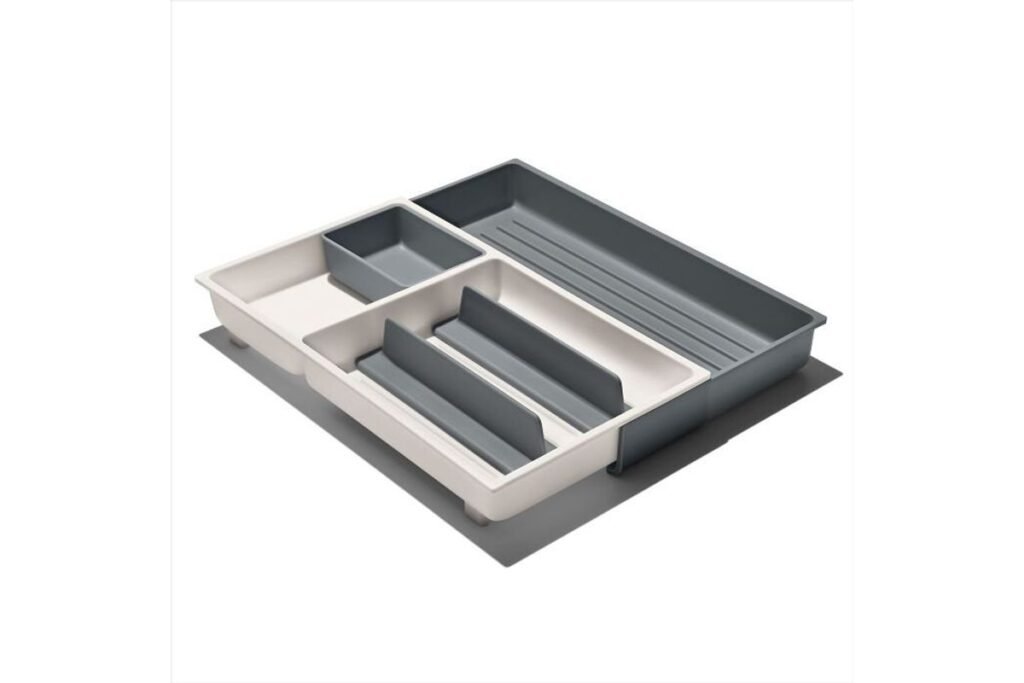
Buying organizers by popularity is how small kitchens end up with a collection of empty plastic boxes. A better approach is to identify where the clutter lives and choose a tool built for that geometry. For this guide, three products solve three different problems: the OXO Large Expandable Kitchen Tool Drawer Organizer for mixed utensils, the YouCopia StoreMore Bakeware Rack for vertical pan and board storage, and the Joseph Joseph DrawerStore Compact Cutlery Organizer for flatware in a narrow drawer.
Quick picks: choose by the mess you see
Best for mixed cooking tools — OXO Large Expandable Kitchen Tool Drawer Organizer: choose it when spatulas, tongs, peelers, and small gadgets share one chaotic drawer.
Best for pans and cutting boards — YouCopia StoreMore Bakeware Rack: choose it when you keep lifting a horizontal stack to reach one sheet or board.
Best for narrow cutlery drawers — Joseph Joseph DrawerStore Compact Cutlery Organizer: choose it when forks, spoons, and knives need less drawer width, not more compartments.
As an Amazon Associate I earn from qualifying purchases.
1. OXO Large Expandable Kitchen Tool Drawer Organizer — best for mixed utensils

This is the most flexible pick in the group. OXO provides an expandable open area for long or irregular tools, adjustable dividers, a removable small-item cup, non-slip feet, and square corners designed to reduce dead space. That makes it useful when one drawer holds a mixture of shapes rather than a uniform set of forks and spoons.
The strongest decision factor here is adaptability. A utensil drawer changes over time, and fixed compartments can become wrong as soon as you add a new pair of tongs or replace a whisk. The OXO layout can be reconfigured instead of forcing every tool into the same narrow slot.
The trade-off is footprint. A large organizer still occupies drawer volume. If your drawer is overloaded, it may organize the crowd without solving the reason the drawer is too full. Edit duplicates first, then use the tray to create zones.
Best for: spatulas, tongs, peelers, small gadgets, and mixed tool drawers.
Skip if: your drawer is mostly flatware or unusually shallow.
Check the OXO organizer on Amazon
For the deeper decision, read our full OXO drawer organizer review.
2. YouCopia StoreMore Bakeware Rack — best for vertical cabinet storage

The YouCopia solves the opposite problem: objects that are too large and flat for a normal drawer. The current rack uses seven adjustable coated-steel dividers on a non-slip base and measures about 11.6 by 7.4 by 6.4 inches before you account for the cookware extending above it.
The strongest decision factor is access. A vertical lane lets you pull a sheet pan or cutting board without lifting everything stacked above it. Adjustable divider spacing matters because a cutting board, cooling rack, muffin pan, and sheet pan do not need identical widths.
The trade-off is cabinet width. Separating objects takes more side-to-side room than compressing them into a tight horizontal stack. You are spending width to gain faster access and visibility.
Best for: baking sheets, cutting boards, cooling racks, muffin tins, and shallow pans.
Skip if: the cabinet lacks vertical clearance or you own only one or two flat pieces.
Check the YouCopia rack on Amazon
See our full StoreMore Bakeware Rack review for fit and setup details.
3. Joseph Joseph DrawerStore Compact Cutlery Organizer — best for narrow cutlery drawers
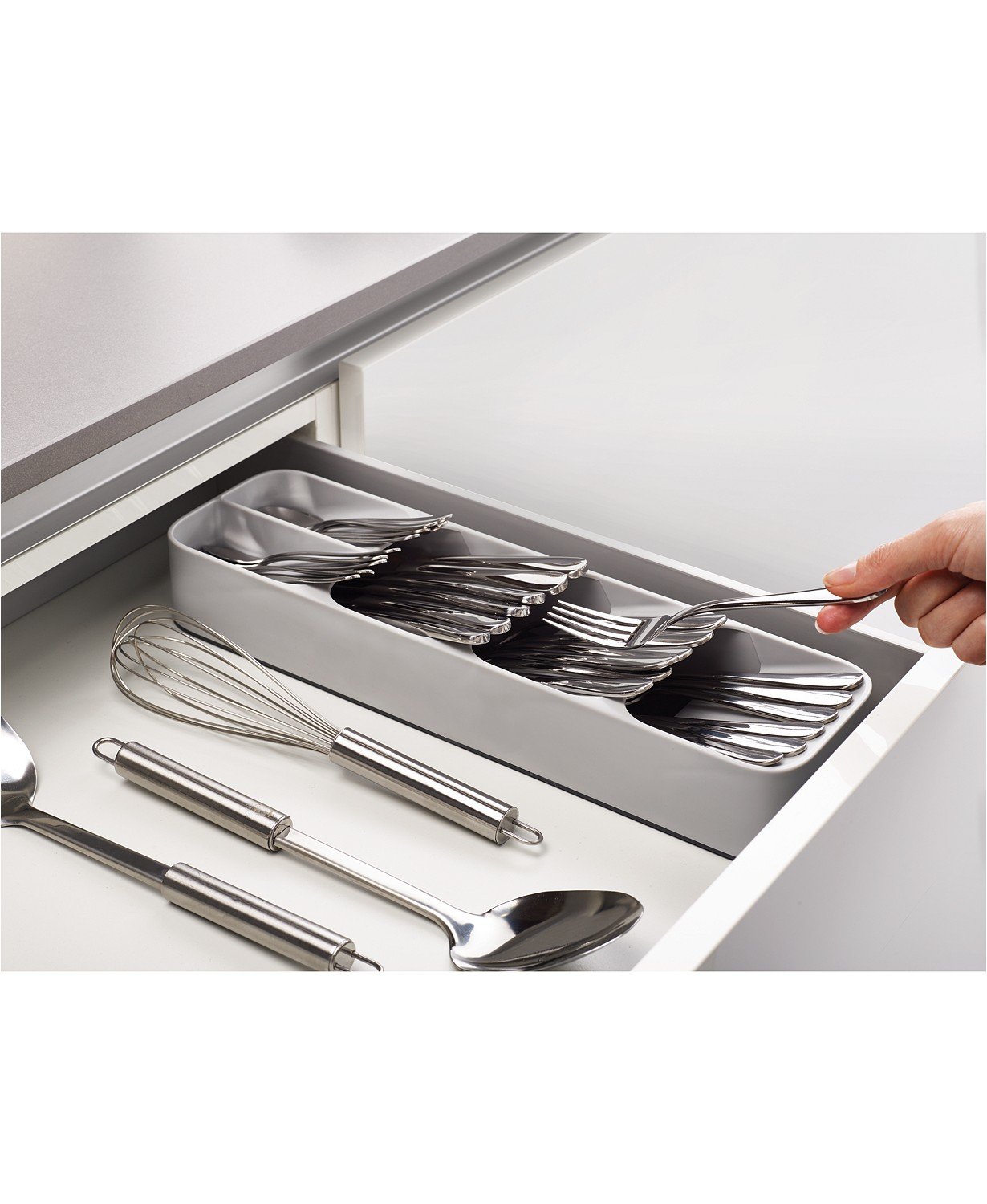
Joseph Joseph takes a different approach from a conventional side-by-side cutlery tray. The DrawerStore uses angled, overlapping compartments for different utensil types. The manufacturer lists model 85119 at about 2.25 inches high, 4.25 inches wide, and 15.5 inches deep, and specifies a minimum drawer height of about 3.25 inches.
The strongest decision factor is width efficiency. Instead of placing forks, spoons, and knives in adjacent horizontal lanes, the stacked design layers them at an angle. This can free a strip of drawer width for other tools.
The trade-off is vertical clearance and visibility. A drawer must be tall enough for the angled stack, and the arrangement is less immediately familiar than a traditional flat tray. People who like to see every piece laid flat may prefer a standard organizer.
Best for: standard flatware in a narrow drawer where width is scarce.
Skip if: the drawer is too shallow or you want large cooking utensils in the same organizer.
Check the Joseph Joseph DrawerStore on Amazon
Side-by-side decision table
| Organizer | Best location | Best for | Key trade-off |
|---|---|---|---|
| OXO Large Expandable | Wide utensil drawer | Mixed tools and gadgets | Uses meaningful drawer area |
| YouCopia StoreMore | Cabinet or pantry shelf | Pans, sheets, boards | Uses cabinet width for separation |
| Joseph Joseph DrawerStore | Narrow cutlery drawer | Forks, spoons, knives | Needs enough drawer height |
How we chose these three
We did not choose three products that all claim to “save space.” We chose three products with different storage mechanics. The OXO controls irregular horizontal drawer space. The YouCopia converts a horizontal pan pile into vertical lanes. The Joseph Joseph compresses flatware width through angled stacking. That difference matters because a product can be excellent in one storage zone and useless in another.
We also prioritized products with current manufacturer documentation and exact Amazon identities that can be checked before purchase. NookPrep did not perform hands-on lab testing for this guide, so we do not assign invented performance scores. The recommendation is based on verified design, dimensions where available, intended storage geometry, and the trade-offs each layout creates.

Which one should you buy first?
If drawers are the daily pain: start with the OXO when the problem is cooking tools, or the Joseph Joseph when the problem is standard cutlery. Do not buy both unless you have separate drawers with separate jobs.
If cabinets are the daily pain: start with the YouCopia. A drawer product cannot fix the annoyance of lifting sheet pans off one another.
If counters are the daily pain: organize the storage area that will let you remove the most countertop clutter. A new organizer is useful only if it changes where objects live.
Small-kitchen rule: measure the object, not only the organizer
This is especially important for the YouCopia rack. The organizer base may fit a cabinet while the cutting board stored in it collides with a shelf above. The same logic applies to drawers: the Joseph Joseph tray may fit its width and depth while stacked utensils hit the drawer above, and the OXO may fit the drawer but leave long handles crossing awkwardly.
Before buying, measure the interior of the storage zone and the tallest or longest object you plan to store there. That two-part check prevents most “it technically fits, but not with my stuff” failures.
What not to buy together
Organization products are easy to overbuy because each one looks tidy in isolation. Avoid stacking solutions on top of one another without a clear role. A cutlery organizer inside a tool organizer can waste space. A pan rack for two sheet pans may create more structure than the cabinet needs. And a large expandable drawer tray may be unnecessary if a simple crock can move the five bulky cooking tools out of the drawer entirely.
The goal is fewer frustrating motions, not more containers.
Three storage mistakes these products can help you avoid
1. Solving a drawer problem with a cabinet product
It sounds obvious, but organization shopping often starts with a product rather than a storage zone. A beautiful pan rack will not help a utensil drawer, and an expandable drawer tray will not make sheet pans easier to retrieve from a low cabinet. Start by naming the one place that frustrates you most.
2. Measuring the organizer but not the stored objects
Every product in this guide can “fit” while failing in practice. Long spatulas can exceed a drawer’s usable length. A vertical cutting board can hit the shelf above a YouCopia rack. Stacked cutlery can exceed the clearance above a Joseph Joseph tray. Measure both the organizer and the objects it will hold.
3. Using organization to avoid decluttering
An organizer can make duplicate tools look orderly without making them useful. Before buying, remove items you never reach for. The remaining collection gives you a much more accurate picture of the space you need.
Decision matrix by kitchen type
| Kitchen situation | Start here | Why |
|---|---|---|
| Studio with one narrow flatware drawer | Joseph Joseph DrawerStore | Targets width efficiency for cutlery |
| Apartment with one overloaded tool drawer | OXO expandable organizer | Handles mixed shapes and long utensils |
| Small kitchen with sheet pans stacked under the oven | YouCopia StoreMore | Converts the pile into vertical access |
| Kitchen with little drawer space but open counter | Consider a utensil crock first | May free a whole drawer without buying another tray |
| Kitchen with too many tools everywhere | Declutter first | No organizer fixes excess inventory |
Can you combine these products?
Yes, but only when they serve separate zones. A kitchen could reasonably use the Joseph Joseph for flatware, the OXO for cooking tools, and the YouCopia for pans if it has three distinct storage problems. That is very different from buying all three because they are “space-saving.”
If your goal is to keep the total number of organizers low, choose the product that frees the most visible or most frequently used space first. Live with that change for a week before adding another. Often, one successful reorganization changes where other items can go and eliminates the need for a second purchase.
A one-minute buying test
Open the exact drawer or cabinet you want to fix and remove the items you used in the last seven days. Put those frequent-use pieces together and ignore the rest for a moment. If the group is mostly forks, spoons, and knives, the Joseph Joseph design is the relevant tool. If it is spatulas, tongs, peelers, and mixed gadgets, the OXO is the better starting point. If the group is sheet pans, boards, and racks, go to the YouCopia.
Then ask one final question: what motion annoys you now? If the answer is “digging,” “unstacking,” or “wasting drawer width,” each of these organizers has a distinct response. If the answer is simply “I own too much stuff,” buying storage is not the first fix.
FAQ
Which organizer saves the most space?
There is no single answer because they save different dimensions. Joseph Joseph targets drawer width, YouCopia targets vertical access in cabinets, and OXO targets flexible use of mixed-tool drawer space.
Which is best for renters?
All three are non-permanent solutions; none requires drilling or mounting. The more important question is whether the dimensions match the cabinets and drawers in your current rental.
Which is easiest to reconfigure?
The OXO and YouCopia both emphasize adjustable components. The Joseph Joseph has a fixed stacked-cutlery layout, so it is less configurable but more specialized.
Do I need an organizer at all?
Not always. If the problem disappears after removing duplicate tools or moving seldom-used gear elsewhere, decluttering may be the better first step.
Match the Fix to the Mess
For most mixed utensil drawers, start with the OXO Large Expandable Kitchen Tool Drawer Organizer. For a cabinet full of trays and boards, the YouCopia StoreMore Bakeware Rack is the more direct solution. For a narrow flatware drawer, the Joseph Joseph DrawerStore is the most specialized space-saving design.
The important part is not picking a universal winner. It is matching the storage mechanism to the shape of the clutter.
The First Storage Product to Buy Might Be Nothing
A crowded kitchen creates a strong urge to buy containers. That urge is often reasonable, but it can also hide the real problem: too many objects competing for the same high-value space. Before choosing any of these organizers, remove duplicates, broken tools, and items you have not used in months. If the drawer or cabinet becomes workable after that edit, the cheapest and most space-efficient organizer is the one you did not buy.
This matters because organizers create boundaries, not volume. They can make access faster and prevent items from collapsing into one pile, but they cannot change the physical dimensions of a drawer or cabinet. A well-organized collection of too many things is still too many things.
Start With the Motion That Annoys You
The three products in this guide solve different motions. The OXO tray addresses searching and tangling inside a utensil drawer. The YouCopia rack addresses lifting and unstacking inside a cabinet. The Joseph Joseph cutlery organizer addresses wasted drawer width by overlapping flatware in a more compact pattern. Those are three different frustrations, even though all of them can be described as “storage.”
Watch what happens the next time you cook. Do you dig under tools? Lift one pan to reach another? Lose most of a narrow drawer to forks and spoons? The repeated motion is a better buying signal than the category label on the product box.
A Neater Kitchen Can Still Be Harder to Use
Some storage systems look impressive when closed and become irritating during cooking. If a utensil must be lifted from under another tool, if a baking sheet slot is too tight for one-handed removal, or if nested cutlery takes extra attention every time you set the table, the visual neatness is not enough.
That is why access belongs in the decision. A small kitchen has limited room for extra motions. The organizer should remove searching, lifting, or reshuffling—not simply make the drawer photograph better.
Measure the Objects Before You Measure the Organizer
Product dimensions matter, but the items you want to store are the harder constraint. Measure the longest cooking tool, the tallest cutting board, the thickest baking dish, and the width of the flatware you actually own. Then measure the usable drawer or cabinet interior. That order prevents a common mistake: buying an organizer that technically fits the furniture but does not fit the collection.
Also account for hardware. Drawer runners, rounded corners, hinges, shelf lips, and door frames can reduce usable space. In cabinets, the tallest stored object may hit the shelf above even when the rack base fits perfectly.
The OXO Is Best When the Drawer Changes Over Time
The expandable OXO tray is the most flexible option here because mixed cooking utensils are difficult to standardize. A peeler, whisk, tongs, thermometer, pizza wheel, and spatula do not share one neat geometry. Adjustable dividers and an expandable section let the layout respond as the tool collection changes.
The compromise is that flexibility can encourage accumulation. An expandable organizer can quietly become permission to keep adding tools. Set a capacity rule before filling it: frequently used tools get prime drawer space; duplicates and rarely used gadgets move out.
The YouCopia Is Best When the Stack Is the Problem
If the most annoying storage moment is lifting several pans or boards to reach one item, the YouCopia rack is the most direct fix of the three. Vertical separation makes each object independently accessible. You give up some packing density because dividers consume width, but you gain faster access.
That trade makes sense in a cabinet you open constantly. It makes less sense for seasonal bakeware that rarely moves. Frequency should decide whether the cabinet width is worth spending.
The Joseph Joseph Is a Specialist, and That Is Its Strength
Compact stacked cutlery storage solves a narrower problem: a shallow or narrow drawer where traditional side-by-side flatware compartments use too much width. The layered design can free adjacent space for another category without requiring a wider drawer.
The limitation is equally clear. It is not a flexible mixed-tool organizer. If you need to store whisks, spatulas, or long utensils, the OXO has a better geometry. Specialized storage works best when the object category is stable and repetitive.
Do Not Buy All Three Just Because They Work
A guide can accidentally turn three good solutions into a shopping list. That is not the goal. Each organizer should solve a problem that exists independently. If your utensil drawer is fine, skip the OXO. If your bakeware stack is easy to reach, skip the rack. If your cutlery drawer has room to spare, compact nesting may add complexity for no benefit.
A small kitchen improves when each purchase removes friction. It gets worse when a “space-saving” product becomes another object that needs space.
The Cost of Storage Is More Than the Price Tag
Every organizer has an ownership cost measured in footprint, cleaning, reconfiguration, and the attention required to put items back correctly. A simple tray may be easy to wipe but use more width. A vertical rack may simplify access but require deliberate spacing. A stacked cutlery design may save width but ask household members to learn a different return pattern.
None of those costs is automatically bad. The question is whether the daily friction removed is larger than the new habit introduced.
Renters Should Prioritize Reversible Wins
All three products are attractive for rentals because they do not require drilling, permanent shelf changes, or custom cabinetry. But portability still depends on dimensions. An organizer that fits one apartment drawer perfectly may be awkward in the next kitchen.
If you expect to move, flexible designs have an advantage. The OXO can adapt to different drawer widths within its range, while the YouCopia dividers can be repositioned around a different collection. The Joseph Joseph remains the most specialized because its value depends heavily on drawer geometry and flatware use.
A Better Order for Fixing a Small Kitchen
Start by removing what you do not use. Then identify the repeated access problem. Measure the objects and the storage zone. Only then choose an organizer. After a week, check whether the annoying motion actually disappeared. If it did not, change the layout before buying another organizer.
This sequence matters because storage products are easiest to judge after the collection has been edited. Otherwise you can spend money arranging clutter instead of reducing it.
Three Kitchens, Three Different First Moves
Kitchen one: the drawer jams when you open it. Do not begin with a bakeware rack. Empty the drawer, remove duplicate tools, then decide whether the remaining mix needs the adjustable OXO layout. The immediate goal is to stop utensils crossing over one another and blocking the drawer.
Kitchen two: the cabinet is technically spacious, but one baking sheet is always trapped. The YouCopia rack has the clearest case. You are not short on volume; you are short on access. Vertical separation spends a little width to remove the lifting and unstacking motion.
Kitchen three: forks and spoons consume an entire narrow drawer. The Joseph Joseph design is the most targeted response because stacked cutlery storage attacks width specifically. Buying the larger OXO tray here could solve the wrong geometry.
These examples show why “best organizer” is usually the wrong question. The better question is which dimension of the kitchen is failing: width, access, mixed shapes, or simple over-ownership.
What Happens After the Organizer Goes In Matters More Than Day One
A storage product can look transformative on installation day because everything has just been sorted. The real test is whether the system still works when groceries arrive, dishes are drying, someone else puts the flatware away, and cooking is happening quickly. If the organizer requires perfect behavior to stay useful, it may not be robust enough for the household.
Choose layouts with obvious return locations. A spoon should have an easy place to go. A sheet pan should slide into a slot without rearranging neighboring pieces. A whisk should not require a puzzle. Systems that recover easily from imperfect use usually stay organized longer than systems optimized for a beautiful first photo.
The Best Purchase Is the One That Prevents the Next Storage Purchase
A good organizer should reduce the urge to add another bin, basket, tray, or rack. If one product creates clear zones and exposes what no longer fits, let that limit guide decluttering. Do not immediately stack a second organizer on top of the first problem.
For a small kitchen, the most successful result is not maximum storage density. It is a smaller number of objects that can be reached without searching, lifting, or moving unrelated items.
The Fastest Decision Shortcut
Name the motion that annoys you before naming the product: digging through mixed utensils, unstacking trays, or surrendering an entire drawer to cutlery. Pick only the organizer that removes that motion. If none of those descriptions matches your kitchen, skip all three. A short list is useful only when it helps you reject products as confidently as it helps you choose one.
What We Would Not Buy for a Small Kitchen
We would not buy any organizer simply because an empty product photo looks neat. A storage product should remove a specific repeated motion—digging, unstacking, or wasting a scarce dimension. If the problem is too many objects, a new organizer can make over-ownership look cleaner without making the kitchen easier to use.
Bottom line: buy the organizer that removes the motion you dislike, not the one that looks best in an empty cabinet photo.
A useful organizer should make the next cooking session easier without requiring another storage purchase to support it. That is the standard behind all three picks.
That is the difference between buying storage and actually fixing storage.
How We Built This Shortlist
NookPrep did not hands-on test these products for this guide. We reviewed current manufacturer documentation and exact Amazon product identities: OXO model 13322100 / ASIN B09B188SM5, YouCopia StoreMore / ASIN B00VG7VZ7I, and Joseph Joseph DrawerStore model 85119 / ASIN B072R6CLRC. Availability and prices can change.
2 thoughts on “Your Small Kitchen May Not Need More Storage—Just These 3 Fixes”
Comments are closed.