The OXO Drawer Organizer Expands. Your Drawer Problem Might Not.
· NookPrep Editorial Team
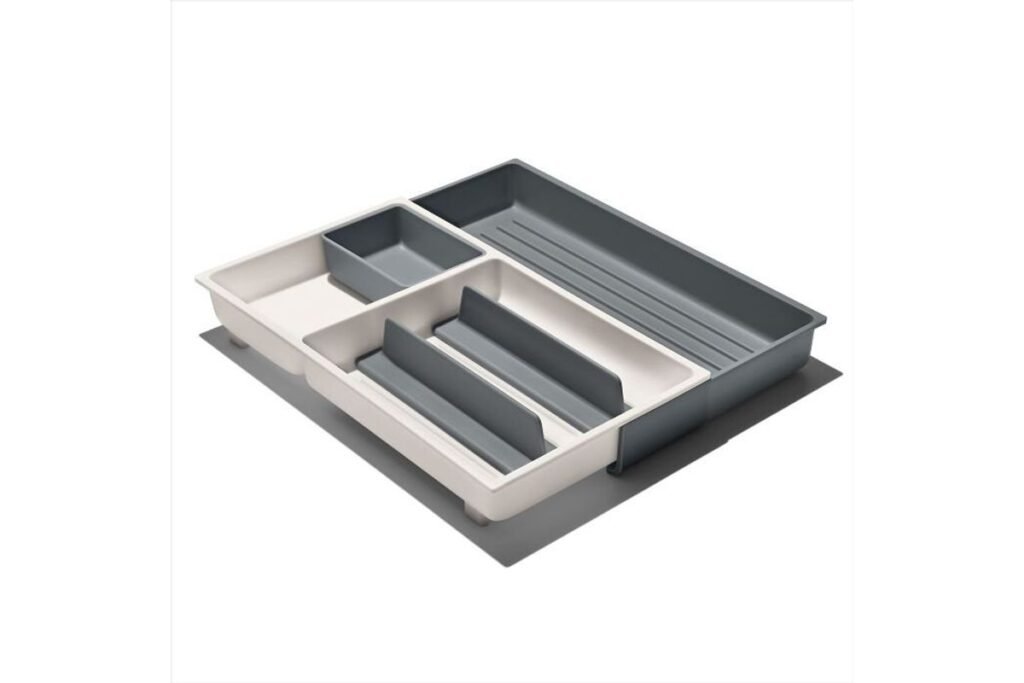
Verdict first: The OXO Good Grips Large Expandable Kitchen Tool Drawer Organizer is a strong fit for a wide utensil drawer that currently wastes space around spatulas, tongs, measuring spoons, and other awkward tools. Its advantage is not that it creates more drawer volume; it makes existing volume easier to use with an expandable open area, adjustable dividers, a removable small-item cup, square corners, and non-slip feet.

Best for: mixed long utensils, irregular gadgets, and drawers where fixed trays leave dead space.
Skip if: your drawer is narrow, shallow, or already works well with a simple cutlery tray.
Main trade-off: flexibility helps messy tool collections, but the organizer itself occupies meaningful drawer area.
As an Amazon Associate I earn from qualifying purchases.
Check the OXO Large Expandable Kitchen Tool Drawer Organizer on Amazon
The real problem is shape, not just quantity
Kitchen tools rarely behave like flatware. A whisk is wide at one end. Tongs may spring open. A peeler is short but bulky. Measuring spoons become a tangled stack. Long spatulas cross the drawer diagonally because a fixed compartment is too short. That is why a generic rectangular tray can look organized while still wasting space.
OXO’s design focuses on irregular tools. The manufacturer describes a large open area for long or odd-shaped utensils, adjustable dividers that let you change the containment zones, and a removable storage cup for small gadgets such as bag clips or wine stoppers. This is a better match for a “tool drawer” than a traditional fork-and-spoon organizer.
The Organizer Has to Change With the Drawer
Adaptability is the most important test for this product because a drawer organizer fails when its compartments dictate what you are allowed to own. Adjustable dividers let you group tools by use or shape instead of squeezing them into fixed slots. The expandable section also gives you more freedom to use the available drawer width.
The trade-off is that flexibility still needs discipline. If every divider is opened wide and the organizer becomes one large catch-all, the benefit disappears. It works best when you deliberately create a few zones: long cooking tools, medium gadgets, and small items.

The Space You Lose Between Tools Matters More Than the Tray
OXO emphasizes square corners to reduce gaps in the drawer. That matters because rounded organizer walls can create strips of unusable space along the edges, especially when the tray is trying to fill most of a rectangular drawer. An expandable format can also reduce the awkward empty channel that appears beside a fixed-width tray.
Still, no organizer can recover space from a drawer that is fundamentally too small for the tools inside it. If the drawer only closes when utensils are pressed down, the better solution may be removing duplicates or moving large tools to a countertop crock.
Tiny Gadgets Are What Turn a Neat Drawer Back Into Chaos
The included storage cup is useful because tiny kitchen items tend to disappear underneath larger tools. Bag clips, corn holders, wine stoppers, and small measuring accessories are exactly the kinds of pieces that make a drawer feel messy even when the larger utensils are grouped. A removable cup gives those items a visible home.
Because the cup and dividers can be removed, cleanup is also more practical than wiping around permanently molded walls. OXO specifically notes that removable pieces support more thorough cleaning. That matters in a drawer where crumbs and seasoning dust eventually find their way underneath the tray.
An Organizer That Slides Around Is Just Another Thing to Manage
Non-slip feet are easy to overlook until a tray slides backward every time you open the drawer. OXO includes them to keep the organizer in place. This is more important in a heavy utensil drawer than in a light cutlery tray because long tools can shift the center of mass as you grab them.
Stability does not compensate for a poor fit, though. Measure the drawer interior—including width, depth, height, and any screw heads or rails that intrude—before buying. The Amazon model identity for this review is ASIN B09B188SM5, model 13322100; exact dimensions should be checked on the current listing before ordering because seller listings can change.

How to decide if an expandable tray is better than a utensil crock
| Priority | Expandable drawer organizer | Countertop crock |
|---|---|---|
| Clear counters | Better | Worse |
| Instant access while cooking | Good if drawer is beside prep area | Excellent |
| Tool visibility | Good when zones are maintained | Easy to see handles, harder to see small tools |
| Cleaning | Requires removing tray/pieces | Simple container cleanup |
| Best for tiny kitchens | Strong if drawer space is available | Strong if drawer space is scarce |
Who should skip it?
Skip this organizer if your drawer is mostly cutlery, because a compact flatware organizer may use the space more efficiently. Skip it if your drawer is unusually shallow; tall handles and stacked gadgets can still prevent closing even when the tray itself fits. And skip it if you need vertical pan or bakeware organization—the YouCopia StoreMore Bakeware Rack solves a completely different storage geometry.
Three drawer scenarios—and whether this organizer helps
Scenario 1: long utensils are crossing over everything
This is the strongest use case. Spatulas, wooden spoons, ladles, and tongs often exceed the length of fixed compartments, so they end up lying diagonally across smaller tools. An open long-tool area can turn those pieces parallel to the drawer and create a cleaner path for the smaller items beside them.
Scenario 2: the drawer is full of tiny gadgets
The removable cup helps, but it is not a complete small-parts system. If the drawer contains dozens of clips, thermometers, corkscrews, and measuring pieces, you may still need to reduce the collection or group similar items in another shallow container. One small cup works best when it catches the handful of pieces that would otherwise drift underneath larger tools.
Scenario 3: the drawer itself is narrow
Expansion is useful only when there is width available to expand into. A narrow drawer may be better served by a compact fixed tray or by moving bulky cooking utensils to a crock. Measure first and treat the organizer’s flexibility as a way to use available width—not as proof that it fits every drawer.
Setup strategy: organize by cooking sequence
Instead of grouping tools only by size, consider how you cook. Put the spatulas, tongs, and wooden spoons you reach for during stovetop cooking in the easiest zone. Keep measuring and opening tools together. Use the small cup for pieces that are easy to lose. This creates a drawer that follows a task rather than a showroom layout.
That approach also helps you identify low-value tools. If an item does not belong to any frequent cooking sequence and has not been used for months, it may not deserve prime drawer space. An organizer is most effective after that decision, not before it.
Value: flexibility is the product
There are cheaper trays that separate utensils. The reason to pay attention to this OXO model is the combination of adjustable zones, expansion, removable pieces, non-slip feet, and a layout made for irregular tools. If you do not need those things, a simpler tray can be better value. If your drawer changes often, the ability to reconfigure may save you from replacing the organizer each time the tool collection changes.
That is the right way to think about value here: not cost per compartment, but how well the tray adapts to the collection you actually use.
Should you buy it?
Choose the OXO organizer when your drawer contains a real mixture of long tools and small gadgets and fixed compartments are the reason the space feels inefficient. The adjustable layout and removable pieces make sense for a changing kitchen-tool collection. If your real issue is simply owning too many utensils, edit the collection first and buy an organizer second.
See the current Amazon listing for the OXO Large Expandable Kitchen Tool Drawer Organizer
FAQ
Does the organizer expand?
Yes. OXO describes an extendable open area intended for long or irregularly shaped kitchen tools.
Are the dividers fixed?
No. The dividers are adjustable and removable, so the internal layout can be adapted to different tools.
What is the small cup for?
OXO suggests small gadgets such as wine stoppers and bag clips. The broader purpose is to stop tiny items from disappearing under larger utensils.
Will it make a small drawer hold more?
It may use awkward space more efficiently, but it cannot create physical volume. If the drawer is overfilled, removing or relocating tools will have a bigger effect.
What to do before expanding the organizer
Expansion is useful only after the drawer has been edited. Before widening the tray, remove duplicate utensils and move rarely used tools out of prime space. Then expand the organizer just enough to create stable zones for the items that remain. This prevents the adjustable section from becoming an excuse to keep filling the drawer.
A good end state is that every frequently used tool can be removed without lifting another one first. If expanding the tray still leaves utensils stacked three layers deep, the drawer needs fewer tools or a second storage location—not a wider organizer.
The Organizer Cannot Fix a Drawer That Is Too Shallow
Expandable organizers are easy to evaluate from width alone, but drawer height and internal obstructions matter just as much. A long utensil can sit neatly inside the tray and still catch the underside of the counter when the drawer closes. Handles can also rise above dividers and collide with utensils stacked on top.
Measure usable width, depth, and height with the drawer fully open. Then look for screws, runners, curved corners, or built-in dividers that reduce the real footprint. The advertised dimensions of an organizer describe the organizer; they do not describe the irregular space inside your cabinet.
Expansion Is Useful Because Kitchen Tools Refuse to Be the Same Shape
Forks and spoons are easy to organize because they repeat. Cooking tools do not. A whisk, peeler, tongs, thermometer, silicone spatula, pizza wheel, and can opener create different lengths, widths, and handle shapes. That is where an adjustable organizer has an advantage over a tray built from identical narrow lanes.
The goal is not to create one compartment for every individual item. That can waste more space than it saves. Instead, group tools with similar motions or sizes so the dividers prevent tangling without surrounding every utensil with unused plastic.
Long Tools Create the Most Expensive Empty Space
A fixed cutlery tray often leaves a long spoon or pair of tongs lying diagonally across several compartments. Once that happens, the neat internal grid stops helping. The expandable open area is useful because it gives irregular tools a zone that does not pretend they are flatware.
However, expanding the tray across the full drawer is not automatically efficient. Every divider wall and every gap between shapes uses some volume. Widen the organizer only enough to stabilize the collection. If the tray expands simply because the drawer has empty width, you may fill the new space with tools that did not deserve to stay.
The Small Cup Is Really a Test of Whether Tiny Things Need to Be in This Drawer
Bag clips, wine stoppers, tiny measuring tools, and loose gadgets are the objects most likely to disappear beneath larger utensils. A contained cup can keep them visible. It can also become a junk drawer inside the organizer if every miscellaneous object gets dropped there.
Use that section for one small category you reach for in the kitchen, not for anything that lacks another home. If the cup fills with batteries, rubber bands, keys, and takeout packets, the organizer has stopped being a cooking system and started hiding household clutter.
The Best Layout Follows the Order You Cook In
Put the tools you reach for while the stove is hot near the front or easiest side of the drawer. Keep occasional baking tools farther back. Group measuring or opening tools together only if they are used in the same part of your routine. This reduces searching more effectively than arranging utensils by appearance.
The test is simple: can you remove the tool you want without lifting or untangling another? If yes, the organizer is doing useful work. If not, moving one divider or removing one duplicate can matter more than adding another accessory.
Sometimes a Utensil Crock Is the Better Organizer
A drawer organizer keeps tools hidden and protected from countertop grease, but it makes every frequently used utensil compete for horizontal drawer space. A crock does the opposite: it spends counter space to free the drawer and keeps spatulas, spoons, and tongs immediately reachable.
If your drawer is shallow or narrow but the counter has an unused corner, moving the longest cooking tools upright can be more effective than expanding a tray around them. The OXO organizer is strongest when the drawer itself is the place you want those tools to live and you have enough usable depth and height to make that decision work.
In other words, choose the storage zone before choosing the organizer. Do not force a drawer solution onto a kitchen whose geometry clearly favors vertical storage.
The Fastest Decision Shortcut
Open the drawer and try to remove your three most-used utensils without touching anything else. If you have to lift, untangle, or dig, an adjustable layout can help. If those tools are already easy to grab and the problem is only that the drawer looks visually busy, a new organizer may improve appearance without changing the cooking experience.
When to Skip It
Skip the organizer when the drawer is physically overfilled, too shallow for your largest tools, or already divided in a way that works. An expandable tray cannot create volume. If removing duplicates fixes the problem, that is the better first move; if long tools clearly belong upright, a crock may use the kitchen geometry more intelligently.
Bottom line: choose the OXO when mixed tool shapes are the problem and the drawer itself is still the right storage zone. If the drawer is simply overfull, edit the collection first.
Finally, think about how often the layout changes. If your tool collection shifts with new gadgets or seasonal baking, adjustable dividers have more value. If the drawer has held the same five utensils for years, a simpler fixed solution may be enough.
A drawer organizer should also shorten the time between opening the drawer and getting the tool you want. If the new layout looks tidy but still makes you scan several crowded compartments, it has improved appearance more than workflow. The best arrangement makes the frequent tools visually obvious and physically easy to lift.
What We Used to Judge the Organizer
NookPrep did not hands-on test this organizer. We reviewed the current OXO product description for model 13322100, exact Amazon identity (ASIN B09B188SM5), the adjustable layout, removable components, non-slip design, and the small-kitchen storage problem it is meant to solve.
If the Drawer Still Fights Back
If you need to organize more than one kind of kitchen object, see our space-saving kitchen organizer guide, which separates drawer tools, bakeware, and cutlery instead of pretending one organizer can solve all three.
2 thoughts on “The OXO Drawer Organizer Expands. Your Drawer Problem Might Not.”
Comments are closed.