
Will the Hamilton Beach 46111 Really Fit Under Your Cabinets?
· NookPrep Editorial Team

A small coffee maker should make your counter easier to use. If you have to pull it forward, move a dish rack, and find somewhere to put a dripping basket every morning, its compact size has solved only half the problem.
The Hamilton Beach 46111 is worth considering when your main frustration is reaching a coffee maker under a wall cabinet. Its front-access layout addresses that problem directly. The catch is that front access still needs working space around the machine. This is a promising small-batch design for a measured coffee station, not a guarantee that any low cabinet will work.
Our judgment here is based on published product information and a related-model care guide, not brewing tests. We cannot tell you how this particular unit tastes, how quietly it runs, or how its controls hold up after a year. What we can do is help you decide whether its layout removes the inconvenience that is making your current brewer feel too big.
Would the 46111 Make Your Mornings Easier?
- Consider it if: you want a small programmable drip brewer and regularly struggle with top-filling a coffee maker beneath cabinets.
- Check before buying: not just the 5.8-inch body width, but the space required for the swing-out basket, carafe removal, cord and comfortable filling.
- Pass if: you regularly need more than a small pot, want measured brew performance, or cannot confirm clearance with the basket open.
Bottom line: FrontFill is a workflow advantage, not proof of better-tasting coffee. Measure your actual morning setup before deciding.
As an Amazon Associate I earn from qualifying purchases.
Check Hamilton Beach 46111 product details on Amazon
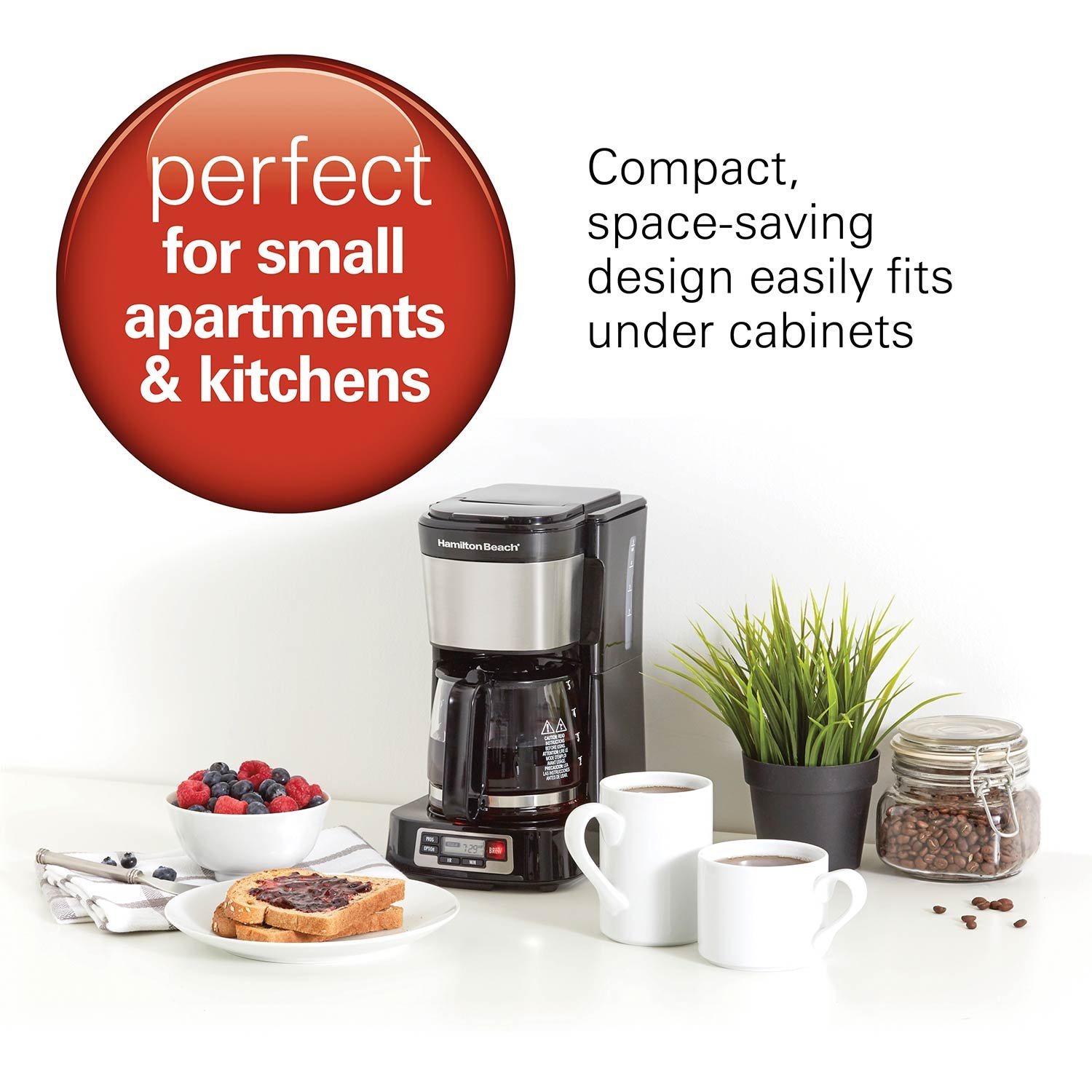
The reason to consider it is access
Hamilton Beach lists the 46111 at 10.3 inches high, 5.8 inches wide, and 8.1 inches deep. Its water entry is at the front, and its brew basket swings outward. The official listing also identifies a programmable clock, a strength selector, a water-level window, a glass carafe, and automatic shutoff after two hours. These are manufacturer specifications rather than measured results. See the exact model listing.
The useful buying question is whether you need access convenience, scheduling convenience, or both. Someone who dislikes moving a brewer may value the layout even without using the timer. Someone with an open counter might care about the clock but gain little from front filling. Identifying the nuisance first prevents a feature list from becoming a reason to buy everything on it.
Think about yesterday's coffee routine. Did your hand hit the underside of a cabinet? Did you move another appliance to remove the filter? Or was the real problem that you wanted coffee ready before you woke up? Those are different problems, and a compact machine can solve one without solving the others.
The footprint is the starting point
Mark a rectangle on your counter using the published body dimensions. Then look at the area in front of it. A machine can sit inside that rectangle while the work of filling, removing the carafe, and handling used grounds extends beyond it.
Do this with paper or removable tape while the counter is empty. Put your usual coffee container, filter box, and mug where you would actually keep them. Leave the dish rack where it normally lives. You are trying to recreate a weekday morning, not an uncluttered product photograph.
If the only way to operate the machine is to remove the entire setup first, its narrow body has not created a useful coffee station. That does not automatically rule it out. An occasional brewer can reasonably be stored between uses. A machine you operate twice daily should have a home that makes those repeated actions easy.
There is no verified open-basket measurement in our evidence that lets us give you a universal side-clearance number. Ask for that measurement when your available space is tight. Do not treat the published width as the width of every operating position.
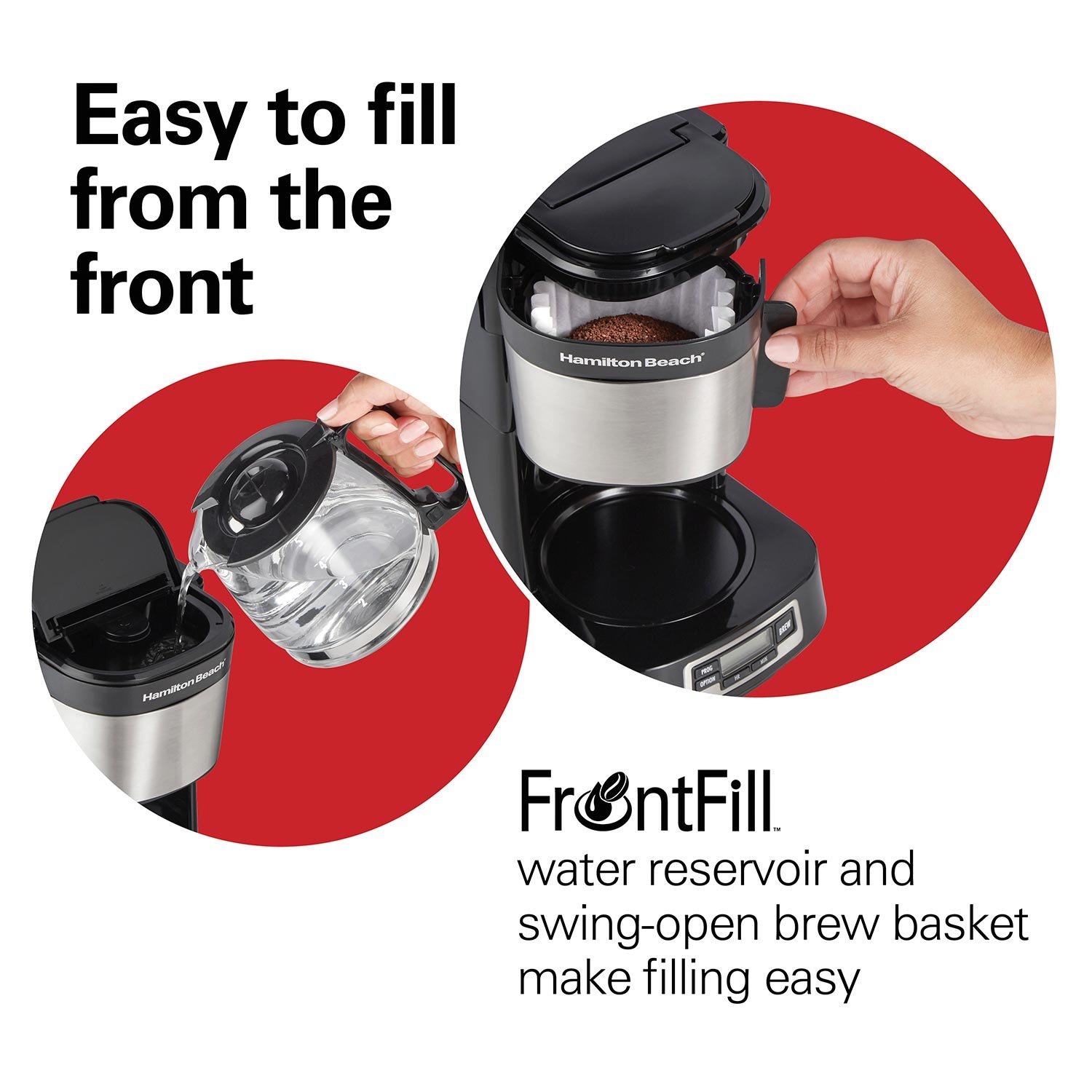
A low cabinet can still be the deciding obstacle
The height of the closed body answers whether the appliance can physically stand beneath a cabinet. It does not establish the access envelope or an approved brewing location. Cabinet trim, an under-cabinet light, and the way you hold a filling vessel can each change the usable space.
Measure from the counter to the lowest obstruction, not to the higher surface behind it. A decorative lip can be the part your hand or lid meets first. Check the intended power outlet and whether the cable would cross a wet area or the movement path of the carafe.
For a cramped installation, describe your space to the manufacturer with separate height, width, and depth measurements. Ask about normal operation, not just whether the machine fits while closed. A useful answer must address filling and basket access as well as placement instructions.
Our recommendation is conditional on that check. The front-access arrangement is a reason to investigate the 46111; it is not permission to ignore heat, moisture, or the care guide. If the location is not suitable for brewing, use another location even if the appliance slides into the gap neatly.
Do a dry access rehearsal before you buy. Put removable tape on the counter to mark the published 5.8-by-8.1-inch footprint, then place the actual mug, filter storage, and water jug you normally use nearby. Work through the sequence without a brewer: reach for water, imagine approaching the front-fill opening, make room to swing the basket toward you, and move a full carafe away from the imagined warming plate. Note every collision or awkward reach. This cannot establish the exact operating clearances of a 46111, because the open basket, hand position, and water-pour arc have not been measured here. It can, however, reveal a counter arrangement that is obviously impractical before you pay for it. If the path is blocked, get the manufacturer’s access-clearance guidance rather than assuming the published closed-body measurements prove a fit.
Five cups does not mean five big mugs
The Hamilton Beach 46110 use-and-care guide, for a related compact model, defines a coffee cup as 5 fluid ounces. On that basis five cups would mean a nominal 25 fluid ounces, not five large mugs. However, that PDF is labeled for model 46110, not 46111. Treat the 25-ounce figure as a related-model illustration until you confirm it against the 46111 documentation or reservoir markings; it is not an independently verified 46111 capacity measurement.
For an illustrative calculation, two 12-ounce servings require 24 ounces before allowing for the difference between water added and coffee delivered. Two 16-ounce travel mugs require 32 ounces. These are arithmetic examples using hypothetical mug sizes, not tests of this machine.
Measure how much coffee you normally pour, rather than guessing from the number of cups in the product name. Include the second serving you actually drink. If your routine often exceeds the small-batch format, buying a narrow machine may replace a space problem with repeated brewing.
This is also where a couple can have different needs from a solo buyer. Two modest servings and two large travel mugs are both a two-person routine, but they do not ask the same thing of a carafe. Buy for the routine, not a household label.
Programming only helps if you prepare the batch
A timer moves the start of brewing; it does not remove the preparation work. You still need to set up the water, coffee, filter, and carafe according to the instructions. The question is whether doing that in the evening is easier for you than doing it in the morning.
Consider a predictable weekday routine. If you leave home at a similar time and drink a similar amount, preparing the machine ahead may be useful. If your schedule changes often, a timer may be a feature you rarely activate. Neither habit is wrong, but paying attention to it changes how much value the clock adds.
Make a simple comparison between a clock model and a manually started one. Write down what actually changes in your morning. If the answer is only pressing a button, the extra convenience may be modest. If it lets you start breakfast while coffee is already being prepared, the benefit may matter more.
We do not infer better extraction or hotter coffee from the presence of programming. Those need separate evidence. Scheduling is a workflow feature, and judging it as one keeps expectations realistic.
A strength setting is not a taste verdict
The product listing includes a brew-strength selector. We have not measured its effect on extraction, brew duration, or flavor. It would be misleading to turn that specification into a claim that the 46111 makes richer or better-balanced coffee than a simpler machine.
Before buying a replacement because you dislike the flavor, separate a machine-layout problem from a recipe problem. If your current brewer is functioning normally, changing the appliance may leave the same dissatisfaction when you use the same coffee and preparation routine. Our guide to bitter coffee approaches flavor complaints separately from footprint.
If you want an appliance with a particular strength control, the 46111 deserves a closer look. If you want evidence of a particular cup quality, specifications alone will not provide it. Look for tests that describe their coffee, recipe, and method, or evaluate the machine within the seller's actual return terms.
That distinction protects a budget as well as expectations. Buying an access feature to fix an access problem is a clear decision. Buying a feature name because it sounds like a flavor guarantee is a much less reliable one.
Pouring early has a boundary
The family care guide describes a temporary pause when the carafe is removed and requires returning it within 20 seconds because water continues entering the basket. Follow the exact instructions supplied with your unit; the pause feature is not a way to leave the carafe away indefinitely.
For a buyer, this is a reminder that convenience features can still require attention. If your habit is to remove the pot and walk to another room, a brief-pour feature should not be treated as support for that routine. Finish the appropriate action and return the carafe as instructed.
We would not choose this machine mainly because it lets someone interrupt a brew. That is a secondary convenience. The stronger purchasing reasons are whether the capacity and access arrangement fit the daily setup.
It is also worth making sure everyone using the machine understands the same routine. A household appliance is often used by someone who never read the product description. Keep the supplied care guide available and explain limitations that are easy to miss from a button or marketing name.
Cleaning is part of the space calculation
An accessible basket is useful only if you can deal with the used filter and return the cleaned parts without rearranging the kitchen. Decide where those actions happen before judging the coffee station complete.
Imagine the machine fully cooled after breakfast. Where will the used filter go? Can you carry the parts to the sink without moving a hot toaster or reaching across clean dishes? Where can the pieces dry without occupying the only preparation board?
This is our practical evaluation framework, not a report of cleaning this model. It applies especially when a small kitchen shares one stretch of counter between food preparation and appliance storage. A brewer may be easy to reach yet still leave its supporting tasks in an awkward place.
Use the exact care instructions for cleaning methods and permitted parts. Do not improvise a stronger descaling solution because another coffee maker's guide uses it. Also check the route for obtaining a compatible replacement carafe or basket. The purchase is easier to live with when normal maintenance and accidental breakage have a clear next step.
How the simpler CM0700B changes the choice
The BLACK+DECKER CM0700B is an alternative worth examining when you want to start a small batch manually and do not need the 46111's scheduling feature. The official BLACK+DECKER CM0700B product page confirms its lighted on/off switch and compact five-cup format. This is a comparison of documented controls and everyday access—not a claim that NookPrep tested either machine or measured a difference in coffee taste.
Ask whether the problem you are paying to solve is access or complexity. If you have plenty of room above the machine and want fewer controls, the simpler layout may be attractive. If reaching the fill area is the recurring nuisance, control simplicity alone does not solve it.
Do not compare these machines by a retailer's abbreviated title. Use their exact model numbers, access arrangements, capacity definitions, and care instructions. A similar-looking unit can have different controls, and a suffix should not be ignored merely because the photograph appears familiar.
The sensible comparison is between two complete routines. One may trade more setup choices for a more convenient morning. The other may trade those choices for straightforward manual use. Neither is automatically the better appliance for every small kitchen.
When a carafe is the wrong answer altogether
If you want one serving and never return for another, the decision may be between batch brewing and a different coffee routine rather than between two five-cup machines. A carafe brings a useful way to share coffee, but it also becomes another item to handle and clean.
Conversely, a single-serving format can look smaller while creating repeated preparation for two drinkers. Consider the whole morning before choosing the smallest machine in a photograph. How many separate brewing actions are you willing to do? Where will the coffee or pods be stored? What equipment will remain on the counter?
Our compact coffee-maker shortlist compares different formats. Use it if you are still undecided about the type of brewer. This review's narrower question is whether the 46111's front-access design matches a particular small-batch station.
A product can be a good answer to that narrower question without being the category's universal winner. Keeping those decisions separate avoids buying a convenient version of a format you never really wanted.
The cases in which we would pass
We would keep looking if your normal morning needs more coffee than this format can comfortably provide. Repeating a small batch is a valid choice, but it should be deliberate rather than discovered after purchase.
We would also pass on a tight installation whose working clearance has not been confirmed. A drawing that shows the closed body fitting into a niche is incomplete evidence for a daily appliance. The place has to permit the actual motions involved in use.
If your priority is a tested flavor result, a glass-versus-thermal preference, or a specific maintenance outcome, this research-based review does not supply a hands-on verdict for those points. Match the evidence to the reason you are buying instead of treating every favorable feature as confirmation of everything else.
Finally, do not buy an exact model simply because a marketplace result uses its name. Check the selected item, included parts, seller, electrical specification, warranty applicability, and return conditions. A review of the US 46111 is not a promise about every regional version or every seller's package.
Make the final decision with your counter
Before ordering, set down the footprint outline and walk through filling, basket access, pouring, and cleanup. Use your normal mug and the accessories that really belong beside the machine. If possible, obtain the missing operating-clearance measurement for the space you have.
Then ask one final question: which repeated annoyance disappears? If the answer is having to reach awkwardly into a brewer under a cabinet, the 46111 has a clear reason to be on your list. If the answer is uncertain, pause before buying another appliance that may leave the same routine intact.
Check the carafe before checking the price
If you are comparing new and used offers, ask whether the exact carafe, lid, and brew basket are included. A compact brewer missing a model-specific part may be less convenient to own than the price suggests. Do not assume a visually similar replacement fits or works safely; obtain confirmation for the exact model. This matters especially when a seller uses a generic stock photograph rather than showing the package you will receive. A cheap offer with unresolved parts is a different purchase from a complete machine with clear return conditions.
As an Amazon Associate I earn from qualifying purchases.
View the Hamilton Beach 46111 listing on Amazon
Check the exact model and current seller terms before ordering. A listing link is not a claim that a particular price, stock level, or delivery date is available.
For the right station, the 46111's appeal is practical: a small batch and an access arrangement designed around everyday inconvenience. The purchase makes sense when those are your actual constraints. Start with the counter measurements, and let the product earn its place from there.
1 thought on “Will the Hamilton Beach 46111 Really Fit Under Your Cabinets?”
Comments are closed.