Countertop vs Portable Dishwasher — Don’t Waste Your Kitchen Space
· NookPrep Editorial Team

A dishwasher can clear your sink and still make your kitchen harder to use. Choose a countertop model if you can surrender a permanent patch of worktop; choose a wheeled portable if you can spare a parking spot and a clear route to the sink. Before buying either, check the space it needs while loading and running—not just where the closed machine fits.
That is the real countertop vs portable dishwasher decision. Below, compare the daily trade-offs, identify the setup worth shortlisting, and use a five-step check to avoid buying an appliance that gets in your way.
Research-based buying guide. We reviewed manufacturer specifications and installation guidance; we have not physically tested these appliances. Recommendations concern placement and workflow, not measured cleaning performance.
Keep the walkway clear, provided you still have a usable food-prep area.
It needs a realistic home on the floor, plus room to roll, connect and load.
It can remove the inlet connection, but you still need drainage and a suitable outlet.
Countertop vs portable dishwasher: compare the right two things
“Portable” is an ambiguous shopping label. Retailers may use it for small countertop machines as well as larger appliances on wheels. Here, countertop means a unit that sits on a worktop, and wheeled portable means a floor-standing machine you move to the sink. A built-in dishwasher is a separate installation choice. Whirlpool’s format guide makes the broader use of the word portable clear.
| What matters | Countertop | Wheeled portable |
|---|---|---|
| Space you commit | A section of the worktop, usually near drainage | Floor parking plus operating and loading space |
| Water supply | Faucet connection; some models also have a manual-fill tank | Typically a temporary faucet connection; check the exact manual |
| Daily setup | Can remain in place; filling or connection may still be necessary | May need to roll out, connect, disconnect and return to storage |
| Load size | Check rack layout and your largest dishes carefully | Generally a larger chassis; usable capacity remains model-specific |
| Hidden fit problem | Cabinet clearance, open door and access to the tank | Tight turns, thresholds, door swing and a blocked walkway |
| Poor match when | It removes your only useful chopping/prep area | There is no place to park it without obstructing the room |
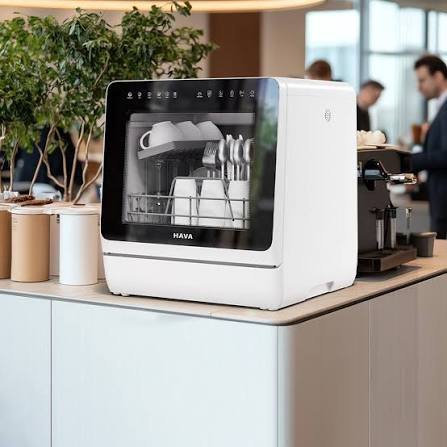
The three setups have different everyday compromises
A tank-fed countertop dishwasher suits an awkward faucet
A manual-fill model is worth investigating when the faucet connection is the obstacle. HAVA’s R01/R09 guidance describes filling a built-in tank with a pitcher and draining through a hose. The important distinction is that skipping the inlet hookup does not eliminate wastewater, power or placement requirements.
Reason to choose it: you can make the appliance location work without relying on a compatible faucet adapter. Reason to skip it: reaching the fill opening or carrying water is an inconvenient daily chore. Before ordering, rehearse the movement with an empty jug beneath your upper cabinet; a technically fitting machine may still be awkward to fill.
Our water tank vs faucet hookup guide goes deeper into this choice.
A faucet-fed countertop dishwasher needs more than a vacant corner
A wider countertop design can be sensible if rack capacity matters more than preserving every inch of the worktop. For context, Danby’s DDW631SDB is a six-place-setting model measuring 21.65 × 20.65 × 17.25 inches, in width–depth–height order. That is about 55.0 × 52.5 × 43.8 cm: short enough to merit a cabinet-clearance check, but hardly a small object on a narrow counter.
Reason to choose this format: you have a permanent location near a compatible connection and want to examine a larger rack. Reason to skip it: the machine would displace the cutting board, kettle or other essentials every day. “It fits” is not the same as “the kitchen still works.”
Place-setting counts describe a specified collection of tableware, not a promise that your pans, deep bowls and oversized plates all fit together. Compare the rack with a normal day’s dishes rather than selecting solely by household size.

A wheeled portable makes sense only if its entire route works
The attraction is simple: keep a larger appliance off the counter. Whirlpool describes floor-standing portable models that move to the sink for connection, then roll away afterward. Some have a usable top surface, but that feature must be confirmed on the model you are considering.
Reason to choose it: you have suitable floor storage and a convenient sink route, while counter space is your bigger constraint. Reason to skip it: the only parking spot blocks a door, or every wash requires moving furniture. A machine on wheels still has to negotiate the actual route through your kitchen.
Try the complete sequence before comparing wash programs: parking spot → sink → door open → loading position → back to storage. Look at cabinet handles, dining chairs, floor transitions and turning space. An outline on the floor is useful, but also check the height at which the appliance might meet handles or overhanging worktops.
Which would we shortlist for your kitchen?
These are planning scenarios, not test results or universal household rules.
- Studio with a clear counter corner but almost no floor storage: shortlist countertop units. Reject any model that leaves you preparing food over the sink or moving the appliance repeatedly.
- Small kitchen with a spare utility nook and busy worktops: investigate wheeled portables, then prove the route and loading clearance. A parking spot across an inconvenient threshold may defeat the benefit.
- Rental with an uncertain faucet adapter: investigate tank-fed countertop models. Confirm the drain route, outlet and fill access before assuming the setup is simple.
- Frequent cooking with pans and large bowls: compare actual rack diagrams first. A compact machine that fits only part of the daily load may leave your most annoying hand-washing unchanged.
Check the faucet before falling for the features
Photographs cannot establish compatibility. A pull-down spray head, hidden aerator or unusual thread needs an exact adapter check; do not assume that “fits most faucets” includes yours. Confirm compatibility with both appliance and faucet guidance.
The Danby owner’s manual details its Quick Connect setup and electrical requirements. Use the manual supplied for your exact model and region when checking the water supply, drainage and power connection. Do not improvise an extension-cord solution to compensate for a badly chosen location.
Five checks that can prevent the wrong purchase
- Mark the closed footprint. Leave your everyday kitchen items in place. Identify what would lose its home.
- Mark the operating footprint. Add the specified door-opening space, connection clearance and room to stand while loading.
- Rehearse the water routine. Where will you fill or connect, where will wastewater go, and can you still use the kitchen comfortably?
- Check your real dishes. Measure the largest plates and compare the rack diagram with bowls, cups and cookware you regularly wash.
- Confirm the exact regional unit. Check voltage, plug, inlet fittings, warranty coverage and the seller’s return conditions. US specifications do not prove European compatibility.
Buy for the space you can spare every day
Choose countertop when protecting floor space is more important than preserving the whole worktop. Choose a wheeled portable when a usable counter is more valuable and the storage-to-sink routine is realistic. Choose neither until the open door, connections and your everyday dishes have passed the fit check.
If the tank-fed direction wins, continue to our countertop dishwashers with water tanks. For the full set of setup guides and model comparisons, explore the small-kitchen dishwasher hub.