
Countertop Dishwasher Water Tank vs Faucet Hookup: Which Setup Is Better for a Small Kitchen?
· NookPrep Editorial Team
The wrong water setup can turn a countertop dishwasher into a daily annoyance. A built-in tank avoids faucet compatibility problems, while a faucet hookup saves you from refilling water by hand. For a small kitchen, rental, RV, dorm, or studio, that choice matters more than almost any extra wash mode.

Quick Answer
Choose a water-tank model if you rent, have a pull-down or incompatible faucet, move often, or want the simplest no-plumbing setup.
Choose a faucet-hookup model if your faucet is compatible, the dishwasher will stay close to the sink, and you want to avoid manually filling a tank before cycles.
Choose dual-mode if you are not sure which setup you will prefer long term. Models such as the EUHOMY DW001-5 and HAVA R09 support both tank filling and a direct water inlet, which gives you more flexibility if your kitchen changes.
Check the EUHOMY dual-mode dishwasher on Amazon
Editorial note: this guide compares setup types using current manufacturer documentation and published product specifications. NookPrep did not independently lab-test every model mentioned, so manufacturer-listed capacities, temperatures, water use, and connector details are treated as published specifications rather than our own measurements.
Water Tank vs Faucet Hookup at a Glance
| Factor | Built-in Water Tank | Faucet Hookup |
|---|---|---|
| Faucet compatibility | Not required for filling | Adapter and faucet must match |
| Daily effort | You fill the tank manually | No pitcher filling once connected |
| Best fit | Rentals, RVs, dorms, awkward faucets | Permanent counter spot near a compatible sink |
| Drain hose | Still required | Still required |
| Moving the machine | Usually easier | More dependent on hose location |
| Main trade-off | Refilling water | Faucet and adapter compatibility |
What a Built-in Water Tank Actually Changes
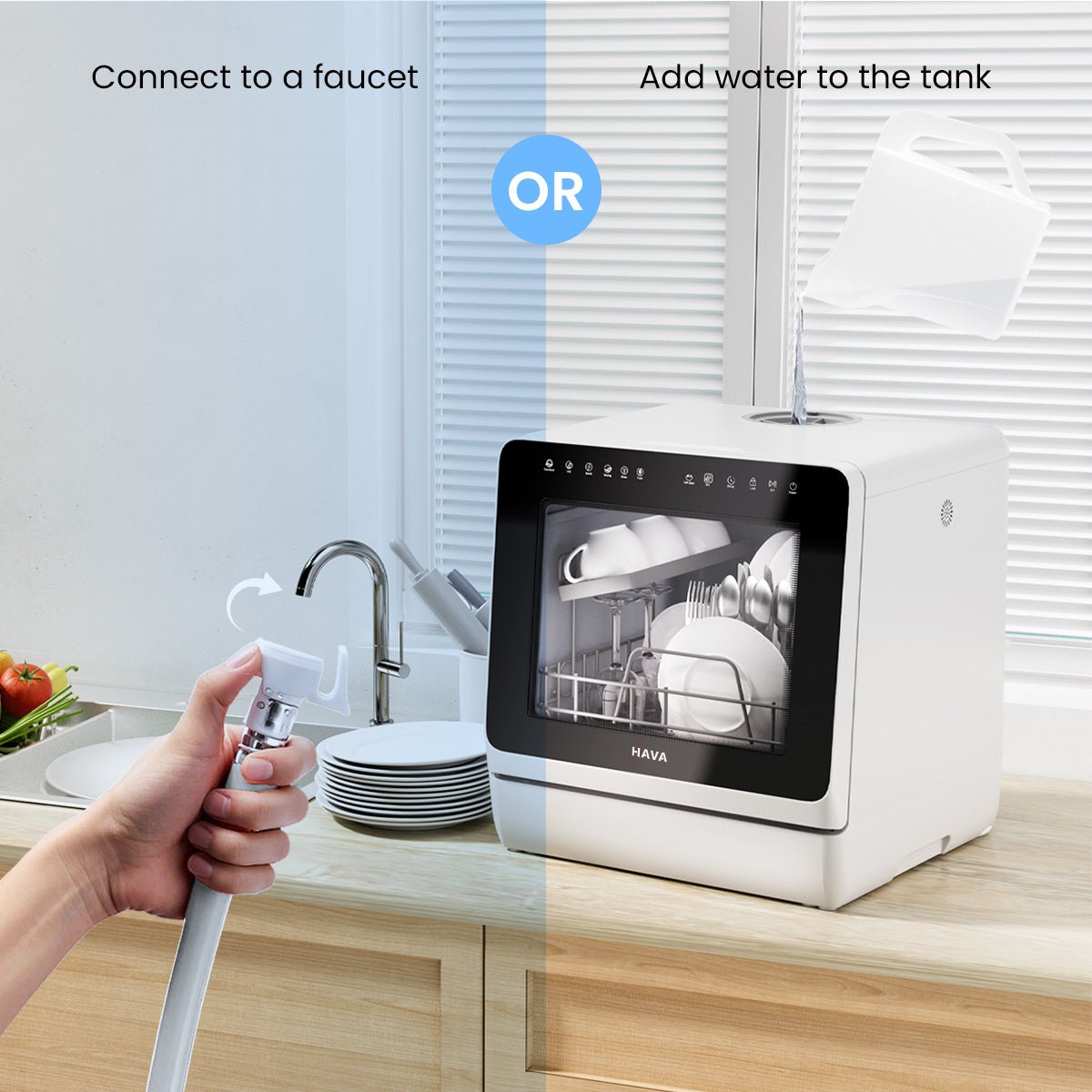
A tank-fed countertop dishwasher stores enough water inside the appliance for a wash cycle. On current compact models, 5-liter tanks are common. HAVA lists a 5 L built-in tank on the R09, and EUHOMY lists a 5 L tank on its dual-mode compact dishwasher. The important practical benefit is not the number itself. It is that the machine can fill without attaching its inlet hose to your kitchen faucet.
That is useful when your faucet has a pull-down spray head, a non-removable aerator, an unusual thread, or a design that does not accept the supplied adapter. It is also useful in a rental where you do not want to leave an adapter on the tap or where the sink is shared with other people.
The trade-off is repetitive. Before a cycle, you have to pour water into the fill opening until the tank reaches the correct level. For an occasional load, that may be trivial. If you run multiple loads every day, the manual step can become the feature you notice most.
The Hidden Limitation of “No Hookup” Dishwashers
No faucet hookup does not mean no setup. A water-tank dishwasher still needs electricity, a stable counter or surface, and somewhere for wastewater to go. In most small-kitchen installations, the drain hose still runs to the sink or another approved drain point.
This is why a tank model is not automatically the answer when your sink is far away. You may solve the incoming-water problem and still have an awkward drain-hose route. Before buying, measure the dishwasher location, the route to the sink, upper-cabinet clearance, door-opening space, and access to the top fill port.
If your counter is especially tight, compare those measurements with our best countertop dishwashers with water tanks for small kitchens guide before choosing a model.
When Faucet Hookup Is Better
A faucet-fed countertop dishwasher draws water directly through an inlet hose. The obvious advantage is convenience: once the connection is made, you do not have to carry a pitcher to the appliance before each cycle.
For a dishwasher that lives permanently beside the sink and runs every day, that can be the lower-friction routine. The machine gets its water automatically, and you only need to load it, add detergent, select the cycle, and manage the hoses according to the manufacturer instructions.
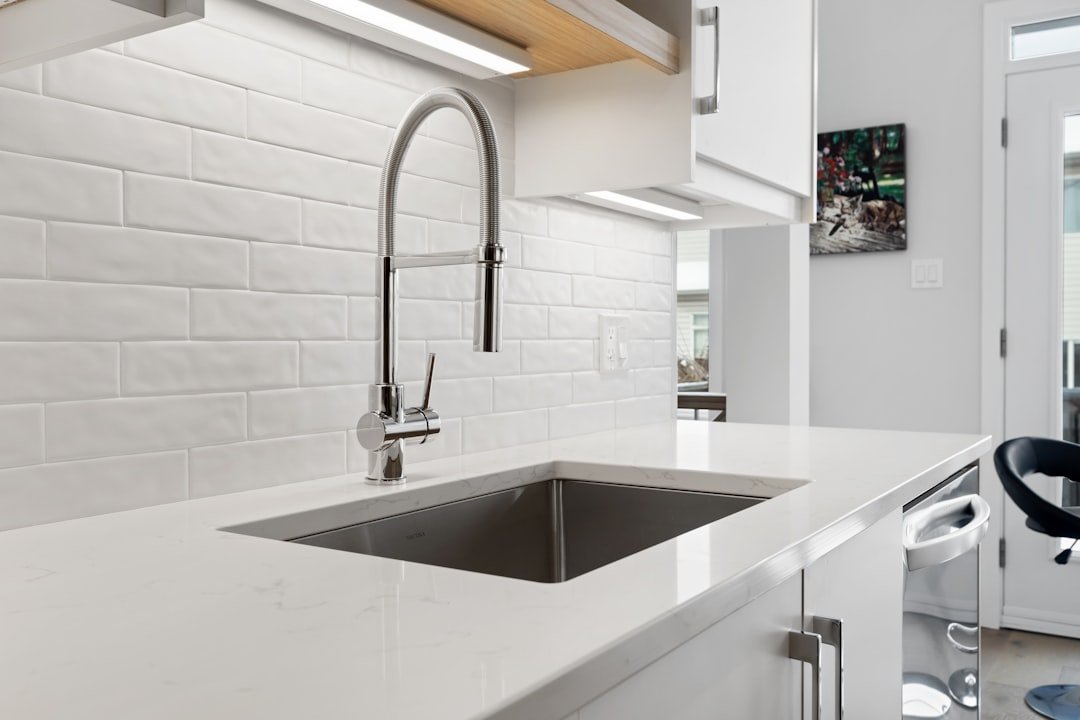
The drawback is compatibility. The included connector may not fit every faucet. HAVA, for example, lists a standard 3/4-inch garden-hose-thread connector for the R09 and notes that an additional adapter may be needed if the faucet does not match. Other brands use their own adapter arrangements. Pull-down and pull-out faucets are especially worth checking before purchase because their spray-head designs often complicate quick-connect fittings.
Tank vs Faucet: Which Is Better for Renters?
For most renters, the tank is the safer starting point because it avoids depending on the faucet connection. You can usually set the dishwasher on a suitable counter, fill it manually, route the drain hose safely, and remove the entire setup when you move.
That does not mean every renter should ignore faucet mode. If your kitchen has a compatible threaded faucet and the landlord has no restriction on a temporary adapter, faucet filling can be more convenient for frequent washing. This is one reason dual-mode models are attractive: you can start with the tank and switch later without replacing the appliance.
Which Setup Makes More Sense in an RV?
An RV or camper often favors tank filling because water access and faucet geometry can vary, and temporary setups are common. But the dishwasher itself still needs a stable surface, suitable electrical supply, safe drainage, and enough clearance to open the door and fill the tank.
Water use also matters when you are working from a limited fresh-water supply. HAVA states that the R09 uses 5 liters per cycle whether the water comes from the faucet or the built-in tank. Always check the exact manual for the model you buy rather than assuming every compact dishwasher uses the same amount.
Which Setup Is Better for Daily Apartment Use?
If you run one load every day and the dishwasher sits directly beside a compatible faucet, faucet mode usually removes one recurring chore: manual refilling. If your tap is incompatible or you want to keep the faucet free from a connector, a tank is easier to live with.
The decision becomes less about cleaning performance and more about friction. Ask yourself which task you would rather repeat: filling a tank or attaching and managing a faucet connection. The right answer is the one that fits the physical kitchen you already have.
Why Dual-Mode Models Are the Safest Choice for Uncertain Kitchens
Dual-mode machines reduce the risk of choosing the wrong water system. The EUHOMY DW001-5, for example, combines a 5 L built-in tank with an inlet-hose option. HAVA does the same on the R09. If you move from a rental to another apartment, change faucets, or simply decide that manual filling is annoying, you still have another way to supply water.
That flexibility is particularly valuable for buyers choosing their first countertop dishwasher. You do not have to predict exactly how your routine will change after several weeks of ownership.
See current EUHOMY price on Amazon
Five Checks Before You Buy
- Measure the real appliance zone. Include width, depth, upper-cabinet clearance, door swing, cords, hoses, and access to the tank opening.
- Inspect the faucet. Look for a removable aerator, thread type, pull-down spray head, and whether the manufacturer-supplied connector is compatible.
- Plan the drain. Tank mode only solves incoming water. Wastewater still needs a safe drain route.
- Check the regional model. Voltage, plug type, faucet fittings, certifications, and available accessories can differ between the U.S., UK, and continental Europe. Buy the version intended for your market.
- Think about frequency. Occasional users may not care about manual filling. Daily multi-load users may value direct water more.
Water Tank vs Faucet Hookup: NookPrep Verdict
For the smallest and most restrictive kitchens, the built-in tank is usually the easier starting point. It removes faucet compatibility from the equation and works well for rentals, RVs, dorms, and older kitchens.
For a permanent setup beside a compatible sink, faucet hookup is the lower-effort daily routine. You avoid carrying and pouring water before each wash.
If you are undecided, dual-mode is the most flexible answer. You can use tank mode now and direct water later without buying another dishwasher.
FAQ
Do countertop dishwashers with water tanks still need a drain hose?
Yes. A built-in tank removes the need for a faucet connection to supply clean water, but used wash water still needs to drain somewhere according to the manufacturer instructions.
Is a water-tank countertop dishwasher really portable?
It is more flexible than a permanently plumbed dishwasher, but “portable” does not mean you can run it anywhere. You still need a stable surface, power, safe drainage, and enough space around the unit.
Can I connect a tank dishwasher to a faucet later?
Only if that specific model supports both modes. Dual-mode models such as the EUHOMY DW001-5 and HAVA R09 are designed for either manual tank filling or an inlet-hose connection.
Is tank mode less efficient than faucet mode?
Not necessarily. Efficiency depends on the specific dishwasher. HAVA states that the R09 consumes 5 liters per cycle in either supply mode, so the source of the water does not change its listed per-cycle water volume.
What is the best choice for a pull-down faucet?
A built-in tank is often the simplest route because it avoids faucet-adapter compatibility entirely. If you prefer faucet filling, verify the exact connector and faucet requirements in the model manual before buying.
For the broader buying path, see our countertop dishwasher hub for small kitchens, which connects water-tank guides, model comparisons, and focused reviews.
7 thoughts on “Countertop Dishwasher Water Tank vs Faucet Hookup: Which Setup Is Better for a Small Kitchen?”
Comments are closed.