
Air Fryer vs Toaster Oven for Small Kitchens: Which One Deserves Your Counter Space?
· NookPrep Editorial Team
If your kitchen has room for only one countertop cooker, buying the wrong one is not a small mistake—it is a permanent tax on your counter space.
Air fryers and toaster ovens overlap just enough to make the choice confusing. Both can reheat leftovers, cook frozen food, and handle small meals without turning on a full-size oven. But they solve different problems. A basket-style air fryer is built around fast, concentrated airflow and a compact cooking chamber. A toaster oven gives you a wider, flatter cavity that behaves more like a miniature oven and toaster.
For a small kitchen, that difference matters more than feature count. The best appliance is not the one with the longest list of presets. It is the one that replaces the most friction in the way you actually cook.
Air fryer vs toaster oven: the short answer
| Decision factor | Air fryer | Toaster oven |
|---|---|---|
| Best at | Crisping, roasting, fast small portions | Toast, baking, flat foods, small pizzas |
| Cooking shape | Deep basket | Wide tray/rack |
| Cleanup | Usually simpler basket cleanup | Tray, rack, crumb tray, interior |
| Toast | Possible, but awkward on many basket models | Clear winner |
| Fries/wings | Clear winner | Can cook them, but not its core advantage |
| Best small-kitchen buyer | Solo/duo cook focused on fast meals | Buyer replacing a toaster + mini oven |
The biggest difference is not technology—it is shape
People often compare these appliances by wattage, presets, or maximum temperature. In a small kitchen, start with geometry instead. Basket air fryers concentrate food inside a relatively small chamber. That is excellent when you want hot air moving around fries, vegetables, chicken pieces, or reheated leftovers. The tradeoff is that the usable cooking surface can feel smaller than the exterior dimensions suggest.
A toaster oven spreads its interior horizontally. That makes it much better for foods that need to stay flat: bread, bagels, pizza, quesadillas, open-faced sandwiches, cookies, or a small baking dish. You may get less aggressive crisping than a dedicated basket air fryer, but the shape is more flexible for traditional oven-style cooking.
This is why quart capacity and exterior dimensions never tell the whole story. A 4-quart air fryer and a compact toaster oven can occupy a similar amount of visual space while accommodating completely different meals.
Counter-space reality: which footprint is easier to live with?
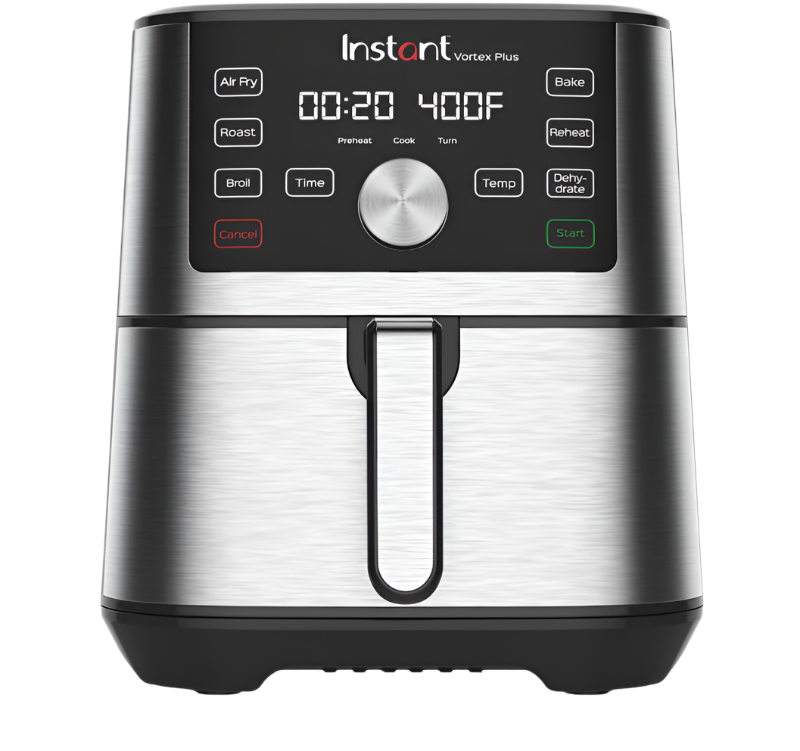
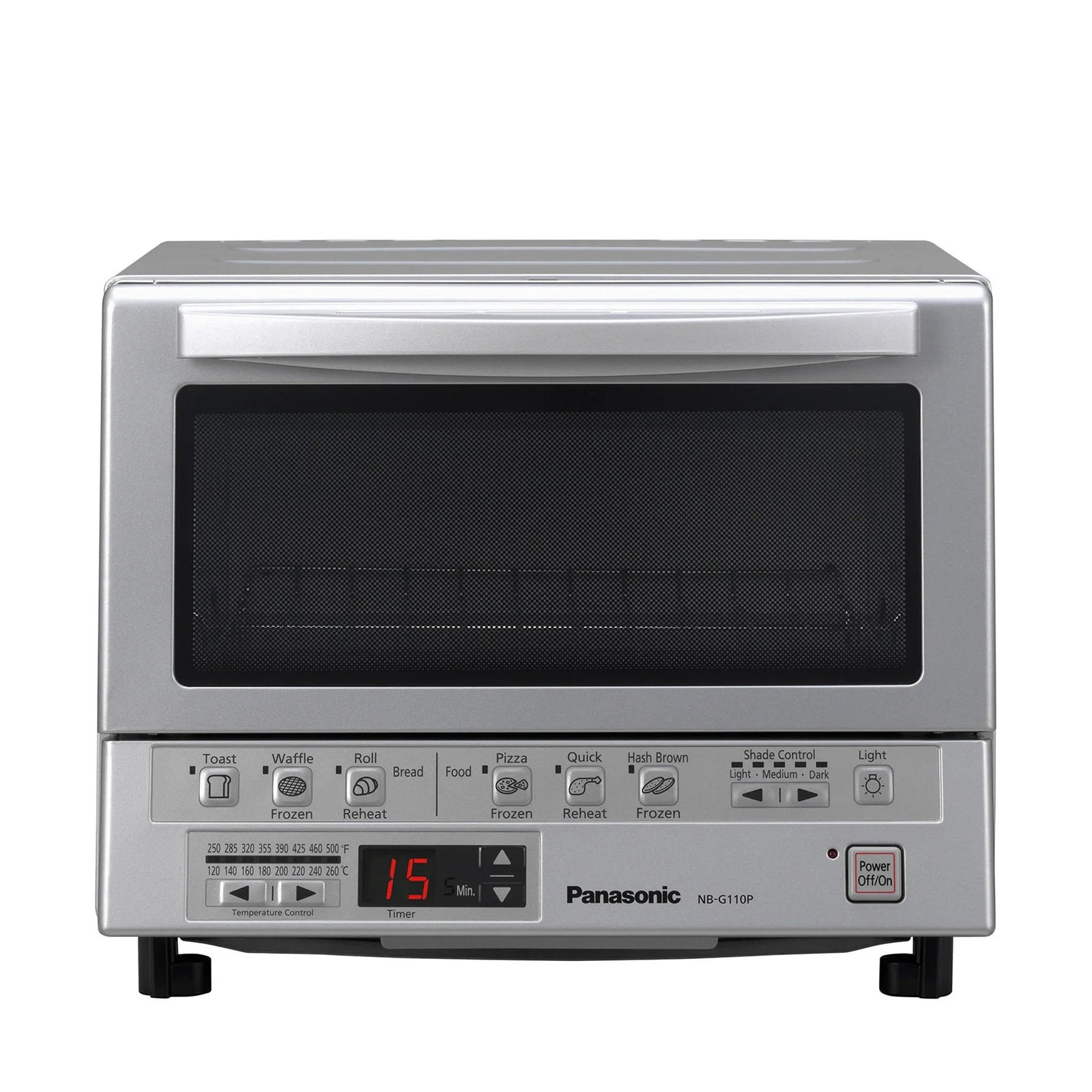
Consider two compact examples already covered by NookPrep. The Instant Pot Vortex Plus 4QT measures about 13.1 inches long, 10.1 inches wide, and 11 inches high according to Instant Pot. The Panasonic FlashXpress NB-G110P is listed at roughly 13 inches wide, 12 inches deep, and 10.2 inches high by Panasonic. On paper, neither is tiny enough to ignore.
The difference is how the space is used. An air fryer needs room in front for the basket to slide out. A toaster oven needs clearance for its door, tray handling, and heat around the appliance. You should always follow the manufacturer’s placement and clearance instructions rather than pushing either appliance tightly against a wall just because it physically fits.
Before buying, measure three things: the appliance footprint, the working space required when its door or basket is open, and the storage path if you plan to move it after use. In a genuinely tiny kitchen, an appliance that fits only when it cannot be operated comfortably does not really fit.
Air fryer wins for crisping and fast everyday portions
A basket air fryer makes the strongest case when your meals are built around small batches. Frozen fries, nuggets, wings, roasted broccoli, Brussels sprouts, potatoes, and small protein portions are natural fits. The compact chamber and airflow are designed around browning and crisping exposed surfaces.
The 4-quart Instant Pot Vortex Plus, for example, is marketed with air-fry, bake, roast, and reheat functions and a 4-quart basket. If even that feels too large, our compact air fryer guide also looks at the COSORI Lite 2.1QT, which is only about 10.1 by 8.3 by 10.5 inches including its handle and is rated at 900W.
That smaller COSORI illustrates the air fryer’s best small-space trick: you can scale the appliance down aggressively if you mostly cook for one. The penalty is obvious—less food per batch. If you routinely cook for two hungry adults, batch cooking can erase the convenience you bought the appliance for.
Toaster oven wins when one appliance needs to replace two
A compact toaster oven becomes compelling when you would otherwise keep both a pop-up toaster and use a full-size oven for small jobs. Panasonic says the FlashXpress uses quartz and infrared heating elements, offers six auto-cook menus, and fits up to four slices of bread or a personal pizza. It also does not require a conventional preheat cycle for its supported use cases.
Breville takes the category in a different direction. Its Mini Smart Oven BOV450 uses four quartz elements with Element IQ, is rated at 1800W, and provides eight functions including Toast, Bagel, Bake, Broil, Pizza, Roast, Cookies, and Reheat. Breville says it can fit four slices of toast or an 11-inch pizza. See both models in our best compact toaster ovens for small kitchens guide.
If breakfast toast, reheated pizza, small baked dishes, and open-faced sandwiches are frequent foods in your home, that flat cooking surface is hard to replace with a basket.
Which is easier to clean?
For many buyers, the air fryer has the edge. A removable basket and insert concentrate most grease and crumbs in parts that can be removed from the appliance. Dishwasher compatibility varies by model, so check the specific manual rather than assuming every basket is dishwasher-safe.
Toaster ovens spread the mess across a larger cavity. Crumbs fall onto a crumb tray, cheese can drip onto a baking tray, and splatter can reach the interior walls or rack. That does not make them difficult appliances, but cleaning tends to involve more surfaces.
There is a counterargument: toaster ovens are easier to visually inspect. You can see the rack, tray, and interior rather than cleaning around a deep basket assembly. If you mostly toast dry foods, cleanup may be minimal. If you roast greasy foods frequently, the dedicated air fryer basket is usually the more contained system.
Which one reheats leftovers better?
It depends on the leftover. For foods where crispness matters—fries, breaded chicken, roasted vegetables—the air fryer is usually the better format. For pizza, toast-like foods, baked goods, or anything you want to keep flat, the toaster oven is more natural.
Microwaves still win when moisture retention and raw speed matter more than surface texture. That is an important small-kitchen point: neither an air fryer nor a toaster oven automatically replaces a microwave. Do not remove an appliance from your kitchen unless the replacement covers the jobs you actually use.
What about power and energy use?
Do not choose based on wattage alone. Rated wattage tells you the appliance’s maximum electrical draw, not exactly how much energy a particular meal will consume. Cooking time, cycling behavior, preheating, food load, and temperature all matter.
For context, the COSORI Lite 2.1QT is rated at 900W, Panasonic lists the FlashXpress at 1300W, and Breville rates the Mini Smart Oven at 1800W. Those numbers are useful for checking whether a circuit can support the appliance, but they do not prove that one category always costs less to run. A smaller chamber that finishes a meal faster can offset a higher or lower rated draw depending on the task.
Air fryer vs toaster oven for one person
Our pick: air fryer for most solo cooks. One-person meals are where the basket format makes the most sense. You can choose a genuinely small 2- to 4-quart model, cook a single portion quickly, and clean a contained basket afterward. It also adds a capability that a microwave and basic toaster do not duplicate very well: concentrated crisping.
But there is one major exception. If your breakfast revolves around toast and your dinners involve pizza, melts, baked dishes, or flat foods, a toaster oven can replace a standalone toaster and become the more efficient use of limited appliance space.
Air fryer vs toaster oven for two people
For two people, capacity starts to matter more. A very small 2-quart air fryer may force multiple batches. Moving toward 4 quarts makes more sense, but now the exterior footprint begins to overlap with compact toaster ovens.
At that point, make the decision from your weekly menu. If you eat crispy proteins and vegetables four nights a week, take the air fryer. If you use toast daily and regularly bake or reheat flat foods, take the toaster oven. If both patterns are common, an air-fryer toaster-oven combo is tempting—but combo models can become significantly larger, so they are not automatically the best answer for a tiny counter.
Buy an air fryer if…
- You cook mostly one or two portions.
- Fries, wings, roasted vegetables, and crispy reheating are frequent jobs.
- You value a removable cooking basket and contained cleanup.
- You already own a toaster you are happy with.
- You want the smallest practical appliance and are willing to accept lower batch capacity.
Check compact air fryers on Amazon
Buy a toaster oven if…
- Toast, bagels, pizza, melts, and baked foods are central to your routine.
- You want one appliance to replace a pop-up toaster and handle small oven jobs.
- You prefer a flat rack or tray instead of a deep basket.
- You need to see and access food easily during cooking.
- Your available counter shape is wider and shallower rather than narrow and deep.
Check compact toaster ovens on Amazon
What if you already own both a microwave and a toaster?
This is the scenario where an air fryer usually has the stronger argument. Your toaster already handles bread. Your microwave already handles fast reheating. A compact air fryer adds a more distinct texture-focused cooking method instead of duplicating jobs you can already do.
If, however, your toaster is old and your full-size oven feels wasteful for one sandwich or a small pizza, a toaster oven can consolidate those tasks. The goal is not to collect every countertop appliance. It is to make each square inch do more work.
Our final verdict: which one deserves the counter?
For most small kitchens: air fryer wins by a narrow margin.
The reason is not that it can do more. It is that it adds a more distinct capability to a kitchen that may already have a microwave and toaster. A compact basket air fryer is especially convincing for one or two people who prioritize crisping, roasting, and fast portions.
But if you need to replace a toaster and reduce full-size oven use, choose the toaster oven. Its flat cooking area and broader traditional-oven tasks can justify the counter space better than a basket.
Before deciding, read our full guides to the best compact air fryers for small kitchens and best compact toaster ovens for small kitchens. If you are deciding which appliances deserve permanent space at all, our guide to kitchen appliances worth counter space is the broader starting point.
How we reached this recommendation
This is a research-based category comparison, not a claim that NookPrep physically tested every appliance mentioned. We compared current manufacturer specifications, dimensions, cooking formats, capacity, functions, and the practical constraints of small kitchens. Our goal is to identify which design better fits a use case, not to manufacture a universal winner. Read How We Review and our Editorial Policy for more detail.
As an Amazon Associate, NookPrep earns from qualifying purchases. Product specifications can change; confirm current dimensions, electrical requirements, clearances, included accessories, price, and availability before purchase.
4 thoughts on “Air Fryer vs Toaster Oven for Small Kitchens: Which One Deserves Your Counter Space?”
Comments are closed.