Best Space-Saving Dish Racks for Small Kitchens: 2 Designs That Give Your Counter Back
· NookPrep Editorial Team
The worst dish rack is the one that stays huge even when there are no dishes in it.
In a small kitchen, drying capacity matters—but so does what happens after the dishes are dry. We picked two racks that solve that problem differently: one becomes narrow when the load is small, while the other folds down for storage.
At a glance
| Rack | Space strategy | Compact size | Best for |
|---|---|---|---|
| Joseph Joseph Extend Slim Steel | Slides longer | 9 W × 12.2 D × 6.3 H in | Leave it out daily |
| OXO Good Grips Foldaway | Folds down | 19.4 × 12.5 × 3.875 in closed | Store after drying |
1. Joseph Joseph Extend Slim Steel — best permanent rack for a narrow counter

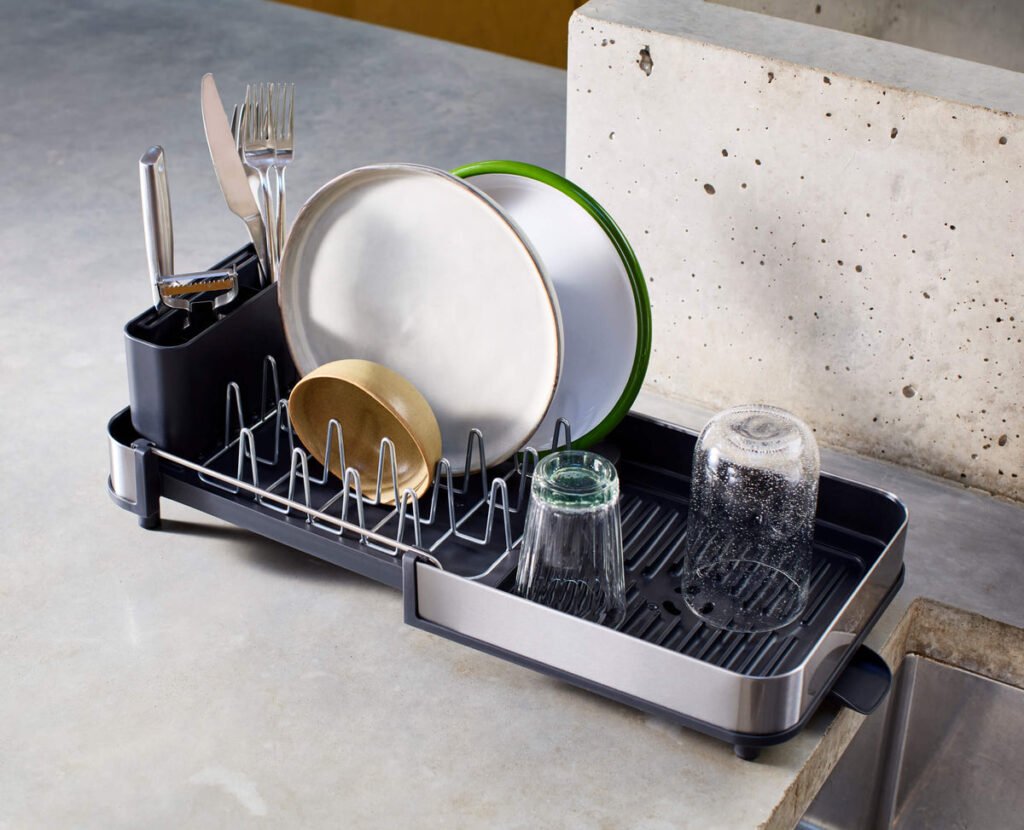
This rack starts with a genuinely small footprint. Joseph Joseph lists it at 9 inches wide, 12.2 inches deep and 6.3 inches high when closed. The important dimension is the width: nine inches is narrow enough to preserve a useful strip of counter beside the rack.
When the washing-up load grows, the sliding tray extends the depth to 20.5 inches while keeping the same width. That makes the design particularly useful in a small kitchen where weekday loads are light but dinner or meal-prep days occasionally need more capacity.
Why the design works
The rack does not force you to reserve maximum drying space all day. It expands only when the dishes require it. Steel prongs hold dishes, the removable cutlery pot includes a knife slot, and the draining spout can be positioned three ways to direct water toward the sink.
That drainage flexibility is more important than it sounds. A compact rack positioned beside a sink is only useful if its drain can actually reach the sink from the direction your counter allows. A fixed spout can turn a good rack into a puddle generator.
The compromise
Expansion happens in one direction. You need enough clear depth when the rack is fully extended, so measure the counter before assuming that “slim” automatically means it will work in every layout. Joseph Joseph also specifies hand washing and drying for the rack itself.
Check Joseph Joseph Extend Slim on Amazon
2. OXO Good Grips Foldaway — best if you want the counter empty afterward

The OXO solves a different problem. It is not especially tiny while doing its job: OXO lists it at 19.4 × 15.5 × 5.125 inches open. Its advantage appears when the dishes are finished. Folded, it becomes 19.4 × 12.5 × 3.875 inches, reducing its bulk enough to slide into a cabinet, pantry, under-sink area or other storage slot.
The plate rack can fold down to make room for cookware and bowls, while internal tines handle cups and glasses. Fold-out feet elevate the rack and a spout drains toward the sink. This is a better fit for someone who values an empty work surface more than keeping a permanent drying station.
Why the design works
A small kitchen often has only one true prep area. If a dish rack permanently occupies that area, the kitchen feels smaller even when no washing is happening. The OXO lets you reclaim that surface after the load dries.
It also has more flexible drying geometry than a minimalist flat mat. Plates can stand upright, larger cookware can use the space created by folding down the plate section, and the utensil holders can be removed for unloading.
The compromise
You need somewhere to store a roughly 19-inch-long object. Folding reduces thickness and depth, but it does not make the rack disappear. If your cabinets and under-sink storage are already packed, a narrow permanent rack like the Joseph Joseph may be the smarter use of total kitchen volume.
Check OXO Foldaway Dish Rack on Amazon
Expandable vs foldaway: which space strategy is better?
Choose expandable when the rack will stay on the counter. Your goal is to minimize its everyday footprint without giving up the ability to handle an occasional larger load.
Choose foldaway when the counter has multiple jobs. Your goal is not the smallest drying footprint; it is getting the drying equipment out of the way when you need to cook.
This distinction matters because “space saving” is not one feature. Some products save space while operating. Others save space while stored. In a very small kitchen, you need to know which kind of space is actually scarce.
What to measure before buying a dish rack
Counter-to-sink distance: confirm the drain spout can reach or direct water into the sink. Usable depth: keep enough front-edge space that the rack does not feel like it is falling off the counter. Storage opening: for a foldaway rack, measure the cabinet or under-sink slot where it will live. Largest daily item: a rack that handles plates but cannot accommodate your pan may force wet cookware onto the counter anyway.
A drying mat is smaller—why not just use that?
A mat is a legitimate option for extremely light loads, but it trades vertical organization for a flat surface. Plates, bowls and glasses can consume more horizontal area when they cannot stand efficiently. A rack makes more sense when you regularly wash multiple rigid items and want airflow around them.
If you mostly wash one mug, one plate and a utensil set, skip the rack entirely. NookPrep’s rule is simple: do not buy organization hardware for capacity you do not use.
How we chose these picks
We did not claim hands-on testing. We compared manufacturer dimensions, operating footprint, stored footprint, drainage design, adaptability and the practical tradeoffs for small kitchens. The Joseph Joseph recommendation is based on its current Extend Slim Steel specifications; the OXO recommendation uses the current Foldaway Dish Rack specifications.
Our broader methodology is explained in How We Review. You can also see our Editorial Policy and our guide to making every inch of counter space earn its place.
Final verdict
The Joseph Joseph Extend Slim Steel is the stronger choice if you want a rack that can remain beside the sink without dominating the counter. Its closed nine-inch width is the key advantage.
The OXO Good Grips Foldaway is the better choice if your counter must be completely reclaimed after the dishes dry. It occupies more space in use but is designed to collapse for storage.
For small kitchens, the winning dish rack is not necessarily the one that holds the most. It is the one that stops occupying valuable space when you no longer need that capacity.
NookPrep is independent editorial media. As an Amazon Associate, NookPrep earns from qualifying purchases. Prices and product availability can change. Product imagery is used to identify the products discussed.
1 thought on “Best Space-Saving Dish Racks for Small Kitchens: 2 Designs That Give Your Counter Back”
Comments are closed.