
Will a Portable Dishwasher Adapter Really Fit Your Faucet?
· NookPrep Editorial Team
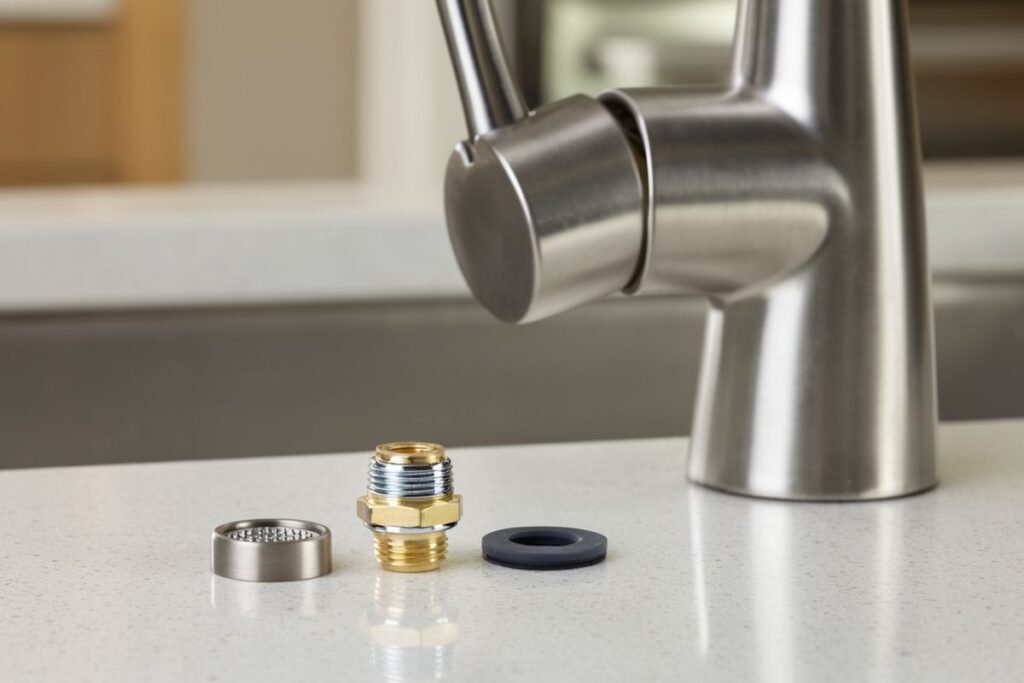
A portable dishwasher can look like the perfect answer to a rental kitchen—until you discover that its connector will not attach to the faucet. The machine may be small enough to fit beside the sink, but its water connection is a different question from its footprint. Before ordering adapters or assuming that any faucet will work, identify the exact dishwasher connection and the kind of faucet outlet you have.
The surprise is that “portable dishwasher” describes several arrangements. A wheeled dishwasher may use a faucet-mounted connector that carries both supply water and wastewater. A countertop dishwasher may connect with its own hose and adapter. A tank-fed countertop model may allow filling with a pitcher and only need somewhere to discharge the used water. Those are not equivalent installations.
Buying a random metal adapter because the photo looks right is a surprisingly expensive way to discover that two fittings are not compatible. Before you order, check these five details against the specific dishwasher and faucet:
- Dishwasher model and connector. Is it a GE-style combined Unicouple, a separate threaded supply hose, or a tank-fill machine with only a discharge hose?
- Faucet outlet. Is there a removable aerator? After safe removal, are the threads inside or outside the spout? An unfamiliar proprietary outlet means compatibility remains unverified.
- Manufacturer’s permitted attachment. Match the actual connector thread and washer specifications in the installation manual; do not infer size from the outer faucet housing.
- Pull-out or pull-down head. Ask the faucet and dishwasher manufacturers whether attachment is allowed. Never force an adapter or rely on an unapproved workaround.
- Drain and clearance. Confirm the waste hose’s allowed placement, the sink’s ability to receive discharge, and room for the dishwasher door and hoses.
If even one answer is missing, pause the purchase. GE’s Unicouple documentation explains its own threaded-aerator connection, while COMFEE’s CDC17P2AWW specifications identify a 15/16-inch male adapter for that model. Neither reference certifies your sink or proves those two manufacturers’ parts are interchangeable.
Illustration notice: The faucet and fittings shown in the Featured image are illustrative only. Their appearance is not evidence of thread size or model compatibility.
Start with the dishwasher’s connection, not the adapter listing
Write down the full manufacturer and model number of the dishwasher you own or plan to buy. Read the manufacturer manual’s installation page. Does it show a combined connector that locks to the faucet? A separate inlet hose with a threaded adapter? A built-in water reservoir with a drain hose? If the product does not need a faucet for filling, do not buy a supply-side adapter merely because other countertop dishwasher owners use one.
GE explains that its portable dishwashers can use a Unicouple arrangement. In that design, one hose supplies water and another returns drain water through a connector mounted to the faucet. GE’s faucet adapter and Unicouple guidance explains how the supplied adapter works with standard threaded spouts and why the paired hoses matter. The same hardware should not be assumed to fit a different brand.
For a countertop example, COMFEE lists an optional quick-connect faucet hose and a 15/16-inch male adapter with its 6L CDC17P2AWW model. That is a specification for that model’s supplied arrangement, not a universal size for every kitchen faucet. Check the COMFEE model documentation before applying any of those dimensions to another dishwasher.
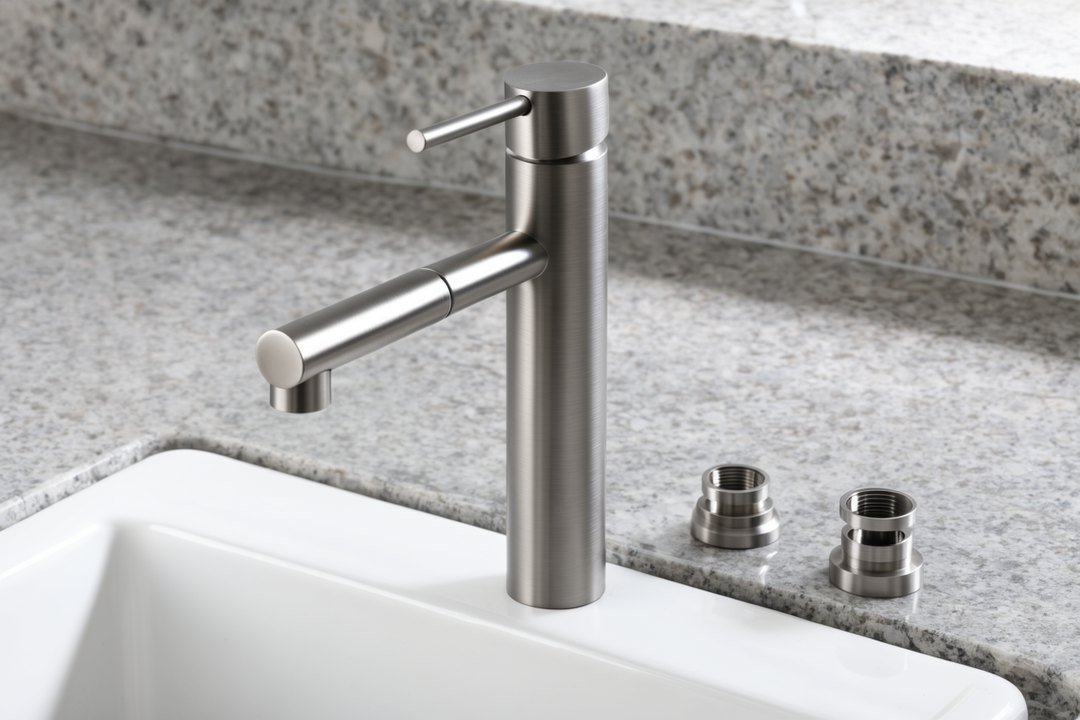
Two faucets that look alike may have different threads
Many kitchen faucets have a removable aerator at the outlet. Under it there may be external threads, internal threads, or a proprietary fitting. The adapter from a portable dishwasher typically expects a particular shape and thread arrangement; rubber washers may also be necessary for the seal. The outside diameter of the faucet body is not enough to determine compatibility.
Whirlpool’s installation instructions distinguish faucets with internal threads from those with external threads and describe different adapter-ring and gasket arrangements. They also tell readers to consult their specific appliance manual. Read Whirlpool’s portable dishwasher installation guidance. An adapter described as “fits most” is not a guarantee, particularly when the faucet has a recessed aerator or a nonstandard outlet.
Do not force threads that do not start smoothly. Cross-threading can damage the faucet and create leaks when someone later reconnects the normal aerator. If the threads are hidden or you cannot identify them, use the faucet manufacturer’s support information or ask a plumber to identify the fitting. Buying several mystery adapters at random often costs more time than this first check.
Pull-down faucets make the decision harder
A pull-down or pull-out faucet is attractive in a small kitchen, but its hose and moving spray head can complicate dishwasher connections. Some manufacturers prohibit connecting dishwasher pressure to particular sprayer or handheld faucet assemblies, while others may offer model-specific solutions. “It screws on” does not prove that the flexible hose and connections are designed for the appliance’s operating conditions.
Older GE portable dishwasher documentation specifically warns about a sink spray-attachment hose when a dishwasher shares that sink; it advises disconnecting that attachment in the installations described. See the older GE Unicouple manual. That warning should make you cautious, not prompt you to dismantle a modern kitchen faucet yourself. For a modern pull-down design, obtain explicit approval from the faucet manufacturer and the dishwasher manufacturer before treating a special adapter as safe.
If you live in a rental, permanent faucet modifications may also require permission. Even if the connection can be made mechanically, it may be a poor daily solution if you must remove a delicate spray head each evening, risk wear at a flexible hose, or leave the sink unavailable for other tasks.
The water source and the drain destination are separate problems
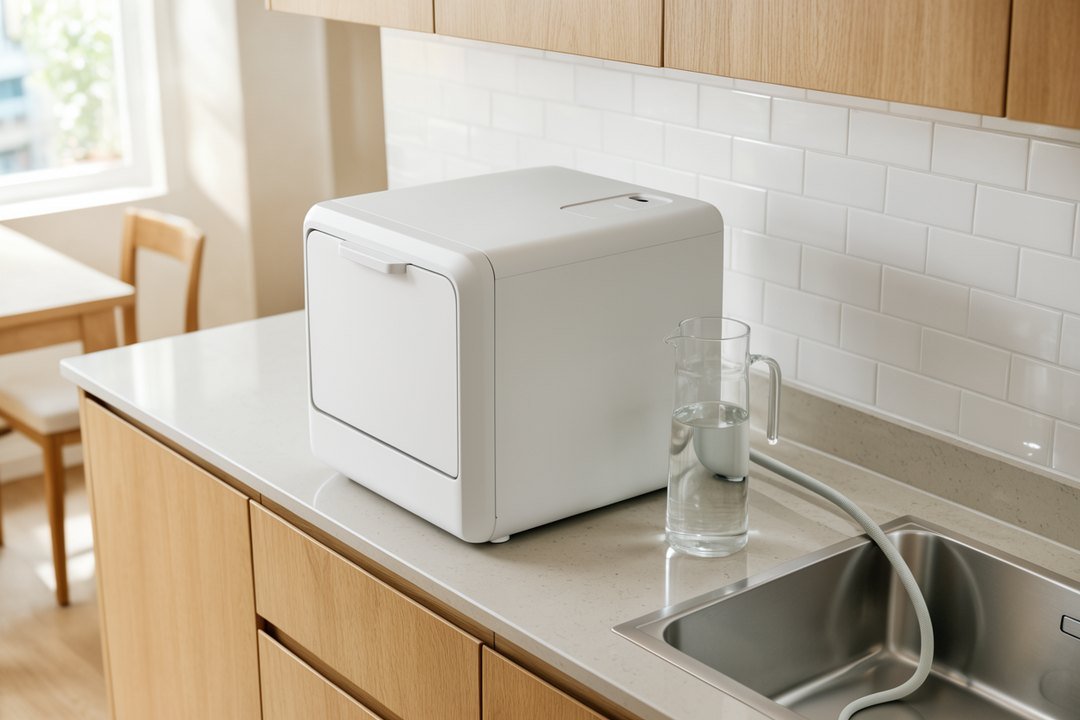
Imagine a countertop dishwasher with a tank that you fill by hand. That may solve the inlet connection entirely. It still needs to discharge wastewater somewhere safe, usually through a hose routed according to the manual. Conversely, a faucet-connected dishwasher can have a perfectly compatible water supply but a drain that will not empty into a clogged sink.
Check that the discharge end is secured over the approved drain or connected exactly as required. See whether the sink empties normally. Follow the manufacturer’s instructions for hose outlet height and placement. Do not copy a high-loop height from a permanently installed dishwasher unless your exact appliance calls for it; countertop and wheeled models have different layouts.
If your decision is really between filling a tank and attaching a faucet hose, our separate tank-versus-faucet dishwasher guide considers the daily trade-off. This article stays with the narrower question of whether the faucet connection you have can work safely.
Measure your working kitchen, not just the faucet
Compatibility is only half of the convenience calculation. Picture a full weekday routine. You pull the dishwasher into position, remove or change the aerator, lock the connector, route the hoses, and run a cycle. Will the connector clear the backsplash? Can the hoses avoid the drawer handles? Will anyone need to use the sink while the dishwasher is running?
A small machine on a crowded counter may still leave too little space to open the door and load plates. A wheeled model might be larger but easier to park elsewhere. The advertised width describes the cabinet, not the entire operating arrangement. Measure the space behind the machine for hoses and power, and the floor or counter area where you will safely load and unload it.
We have not tested the mechanical clearance or faucet fit of your kitchen. These are planning questions meant to reveal incompatibilities before a purchase, not promises that a given connector will fit.
Why a fitting that screws on is not always a suitable dishwasher connection
A connector can engage a faucet thread and still be the wrong choice. The washer may not seal, a pull-down spray head may not be designed to bear the hose load, or the adapter may interfere with how a faucet normally operates. The dishwasher’s water-supply connection also has to match the approved pressure and coupling design. None of these questions is answered by noticing that the metal threads appear to align.
Start from the appliance’s manufacturer, not an unlabelled bag of adapters. Find the exact model and installation diagram. If it calls for a combined hose-and-faucet coupling, use the specified connector arrangement rather than mixing pieces from a different brand. For faucets with a removable aerator, the aerator manufacturer or faucet maker can help identify whether the outlet has internal, external, or proprietary threads. Even after you know that, you still need the dishwasher manufacturer to confirm that an approved connector exists.
A removable aerator is not the same as permission to attach a pressurized appliance hose. When the outlet is part of a pull-out spray head, contact the faucet manufacturer before purchasing anything. Avoid improvised rubber hose clamps, taped joints, forced fittings, and modifications to a rented property’s plumbing. A drip discovered during the first wash is not a harmless compatibility check, especially next to an electrical appliance.
Could the sink become the inconvenience instead of the adapter?
Imagine that you find a certified fitting, connect the dishwasher and then realize that you cannot use the sink normally while the wash runs. On some portable setups, supply and discharge share one faucet-mounted connection. On others, the dishwasher fills from its own tank but still drains into the sink through a separate hose. If the sink is narrow, its receiving basin may be unusable for the duration of a cycle. That can matter more in daily life than whether an adapter costs a few dollars.
Before you order, run through the routine without hooking anything up. Where will you place the machine while you load it? Can its door open completely? Does the power cord reach an appropriate outlet without extension-cord improvisation? Can a secured waste hose discharge according to the manual? Does the kitchen still leave room for chopping, washing produce, or filling a pot? Measuring only the appliance’s advertised width misses the clearance required by the opened door and the connections.
In a rental, you should also consider what happens when you move out. If a faucet modification requires a landlord’s permission, a tank-fill model may be easier to accommodate. But “no faucet connection” does not mean “no installation questions.” A tank machine still needs a suitable drain and stable countertop. Ask for its exact clearance, drain-routing and ventilation requirements rather than relying on a marketing photograph.
These are the decisions that prevent returns. A cheap adapter is not a bargain if it does not fit; an expensive tank-fill dishwasher is not helpful if your sink cannot accept its discharge. When the fitting or route remains uncertain, ask the manufacturers for written guidance before purchasing either.
Do not use a leak as the first compatibility test
Once the two manufacturers confirm compatibility and you have the correct supplied or approved adapter, follow the connection procedure in the manual. A portable Unicouple connector often has a locking collar and pressure-release control; those parts exist for a reason. Whirlpool and GE both provide steps specific to their units. Do not borrow the removal sequence for another model.
Keep the electrical area dry, use a suitably grounded outlet as directed, and stop if the hose, faucet or connection leaks. Do not defeat a locking mechanism, wrap a leaking pressure connection with tape as a permanent fix, or hold a connector by hand throughout a cycle. A fitting that survives a few seconds of water flow has not been proven reliable under an entire wash.
Always turn water off and release pressure using the appliance’s specified procedure before disconnection. Pulling off a pressurized connector may cause splashing or damage. If the installation calls for plumbing changes, have an appropriately qualified person handle them.
When it makes more sense to change the machine instead of the sink
You may discover that the countertop space works perfectly but the faucet does not accept an approved adapter. At that point, a tank-filled unit may be more practical than trying to retrofit an expensive kitchen fixture. Or a dishwasher with a manufacturer-approved fixed connection may make sense if your home allows that installation. Neither is automatically better; you are choosing which recurring task and infrastructure requirement you can comfortably live with.
The other reason to walk away is the operating routine. If you must leave the sink unusable for long periods or repeatedly unscrew a fragile aerator, a tiny machine can create a larger household inconvenience. An appliance earns its place when its setup is as manageable as the cleaning it replaces.
For a broader footprint and plumbing comparison, see how countertop and wheeled portable dishwashers differ in small kitchens. Keep the model, faucet and hose requirement together whenever you compare products.
Would a tank-fill model be easier than another adapter?
If your faucet’s manufacturer does not approve the portable dishwasher fitting, buying a random adapter is not the answer. The COMFEE CDC17P2AWW offers a different compromise: its built-in tank can be filled without connecting an inlet hose to the faucet. That is useful in a rental kitchen with an unusual faucet, but the dishwasher still needs a manufacturer-approved wastewater discharge path into the sink. The unit also takes counter space and must have clearance to open its door.
Before you compare prices, check the exact model and the space around your sink. For an existing GE portable unit, a genuine GE faucet adaptor such as WD01X10383 may be relevant only if GE confirms fit for your complete appliance model and faucet connection; the part number alone is not a universal compatibility guarantee. There is no reason to buy both products.
Affiliate disclosure. As an Amazon Associate I earn from qualifying purchases. These links do not change the troubleshooting advice or make a product a proven repair.
See the COMFEE tank-fill model on Amazon ↗ (paid link)
For a GE portable dishwasher, check GE’s official WD01X10383 part page and ask GE to confirm compatibility before purchasing an adapter.
One more easy-to-miss detail is how you plan to store the original faucet aerator. A dishwasher adapter may require removing it for each wash, and the aerator’s small washer can go missing in a drawer. If your manufacturer approves a removable connection, keep the original parts together in a labelled container and follow the documented attachment and release steps. Never swap adapters while the dishwasher is running or the connection is pressurized. A repeatable, manufacturer-approved routine is more valuable than a clever-looking universal fitting.
When an online listing claims it fits almost every sink, treat that as a reason to check harder. Compare the precise dishwasher model, faucet outlet and manufacturer’s approved part information. The answer may be that none of the available fittings is supported. In that case, choosing a tank-fill machine—or choosing not to buy a dishwasher yet—is a sensible result, not a failed installation.
Bring three facts to the seller or manufacturer
Before paying for a dishwasher, note the dishwasher’s exact model number, the kitchen faucet’s brand and model (or a clear photograph of its aerator outlet), and whether you are allowed to change the faucet fitting. Ask the manufacturer which specific adapter is approved for that combination. If they cannot confirm it, treat fit as unresolved rather than trusting a generic marketplace listing.
Make a second note about the drain. Where will used water go? Can the hose remain secure during operation? Do the manufacturer instructions permit that outlet height and placement? A supply adapter purchase does not solve an unacceptable drain route.
What this guidance can and cannot establish. This is a source-based buying and installation guide, not a hands-on fit test. GE and Whirlpool documentation explain their own faucet adapters, Unicouple connectors, gaskets and procedures, while COMFEE’s official page describes one countertop model’s connection options. They do not prove compatibility with every faucet or supply a substitute for your own model’s installation manual. No recommendation here asks you to bypass appliance safeguards or modify electrical and plumbing equipment without approval.
The simplest outcome may be deciding that your existing sink is fine—and the dishwasher needs to be chosen around it. Check the faucet and drain first. Then look for the appliance that makes the whole routine easier, not just the one that promises to fit on the counter.